Unveiling the Mystery: What is the Product of Cellular Respiration?
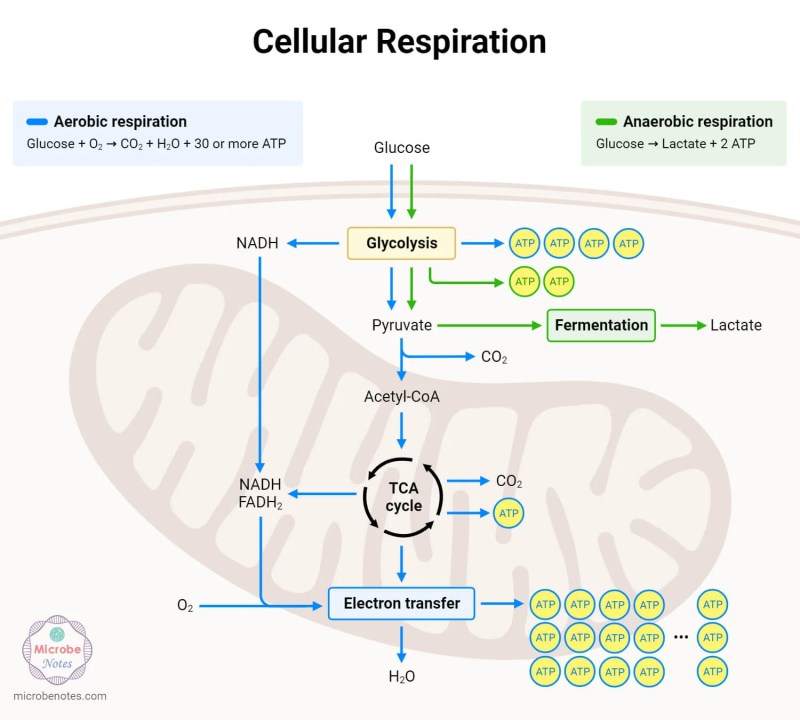
The Complete Overview of What is the Product of Cellular Respiration
Cellular respiration is a fundamental biological process that occurs in the cells of organisms to convert biochemical energy from nutrients into adenosine triphosphate (ATP), the "energy currency" of the cell. This process is essential for the survival of all living beings, from single-celled organisms to complex multicellular creatures. The ultimate goal of cellular respiration is to produce ATP, which powers various cellular activities and maintains the overall functioning of the organism.
The process of cellular respiration can be understood as the body's way of harnessing energy from the food we consume. When we eat, our bodies break down the food into simpler molecules, such as glucose. These molecules are then transported to the cells, where they undergo a series of chemical reactions to release the energy stored within them. This energy is captured and stored in the form of ATP, which can be used by the cell to fuel its operations.
Historical Background and Evolution
The concept of cellular respiration has been understood for centuries, with early scientists recognizing the importance of breathing and the role of oxygen in sustaining life. However, the detailed mechanisms of how cells extract energy from food were not fully elucidated until the early 20th century. In the 1920s and 1930s, scientists such as Otto Warburg and Albert Szent-Györgyi made significant contributions to our understanding of cellular respiration, identifying key enzymes and pathways involved in the process.A major breakthrough came with the discovery of the citric acid cycle, or Krebs cycle, by Hans Krebs in the 1930s. This cycle is a central component of cellular respiration, where acetyl-CoA, derived from glucose and other nutrients, is oxidized to produce reduced coenzymes and carbon dioxide. The reduced coenzymes, such as NADH and FADH2, are then used in the electron transport chain to generate a large amount of ATP.
Core Mechanisms: How Cellular Respiration Works
Cellular respiration can be divided into three main stages: glycolysis, the citric acid cycle (Krebs cycle), and the electron transport chain. Each stage contributes to the overall production of ATP.1. Glycolysis: This initial stage occurs in the cytoplasm of the cell and does not require oxygen. Glucose is broken down into two molecules of pyruvate, producing a small amount of ATP and NADH, a reduced coenzyme.
2. Citric Acid Cycle (Krebs Cycle): Pyruvate enters the mitochondria, where it is converted into acetyl-CoA, which then enters the Krebs cycle. This cycle generates more NADH and FADH2, as well as carbon dioxide as a byproduct.
3. Electron Transport Chain: The reduced coenzymes NADH and FADH2 from the previous stages are oxidized in the inner mitochondrial membrane, releasing energy that is used to pump protons across the membrane, creating an electrochemical gradient. This gradient drives the synthesis of ATP from ADP and inorganic phosphate (Pi) through a process called chemiosmosis.
Key Benefits and Crucial Impact
Cellular respiration is of paramount importance for the maintenance of life. It provides the energy necessary for various physiological processes, ensuring the proper functioning of organs and systems. Without this process, cells would not have the energy to perform their specialized functions, leading to the demise of the organism."Cellular respiration is the engine that drives life. It is the process by which organisms convert food into the energy needed to sustain their existence."
Major Advantages
- Efficient Energy Production: Cellular respiration is an incredibly efficient process, maximizing the energy yield from nutrients. It allows organisms to extract and utilize energy from complex organic molecules, ensuring a steady supply of ATP.
- Sustained Metabolic Function: By providing the energy required for metabolic processes, cellular respiration enables cells to synthesize and degrade molecules, maintain ion gradients, and support active transport, among other vital functions.
- Adaptability: Different organisms have evolved various strategies for cellular respiration, allowing them to adapt to different environmental conditions and nutrient availabilities. This adaptability is crucial for survival in diverse ecosystems.
- Evolutionary Significance: The development of cellular respiration was a pivotal event in the evolution of life on Earth. It allowed for the evolution of complex organisms by providing a more efficient means of energy production, facilitating the increased metabolic demands of higher life forms.
- Integration with Other Pathways: Cellular respiration is intricately linked with other metabolic pathways, such as glucose metabolism and lipid synthesis. It serves as a central hub, integrating various biochemical processes and ensuring the coordination of cellular activities.

Comparative Analysis
| Stage | Aerobic Respiration | Anaerobic Respiration |
|---|---|---|
| Glycolysis | Occurs in cytoplasm, produces 2 ATP | Occurs in cytoplasm, produces 2 ATP |
| Citric Acid Cycle | Occurs in mitochondrial matrix, generates NADH and FADH2 | Does not occur |
| Electron Transport Chain | Occurs in inner mitochondrial membrane, produces 32-34 ATP | Does not occur |
| Total ATP Yield | 36-38 ATP per glucose molecule | 2 ATP per glucose molecule |
Future Trends and Innovations
The study of cellular respiration continues to be a vibrant area of research, with scientists exploring various aspects of this fundamental process. Advancements in biotechnology and genetics are shedding new light on the intricate mechanisms involved, leading to a deeper understanding of energy metabolism and its implications for human health.One emerging trend is the exploration of cellular respiration in the context of personalized medicine. By understanding individual variations in metabolic pathways, researchers aim to develop tailored therapies for metabolic disorders and improve overall health. Additionally, the manipulation of cellular respiration pathways is being investigated for potential applications in bioenergy and biotechnology, offering sustainable solutions for energy production and waste management.
Table of Contents
- The Complete Overview of What is the Product of Cellular Respiration
- Historical Background and Evolution
- Core Mechanisms: How Cellular Respiration Works
- Key Benefits and Crucial Impact
- Major Advantages
- Comparative Analysis
- Future Trends and Innovations
- Conclusion
- Comprehensive FAQs
- Q: What is the primary product of cellular respiration?
- Q: How does glycolysis contribute to cellular respiration?
- Q: What is the role of the citric acid cycle in cellular respiration?
- Q: How does the electron transport chain produce ATP?
- Q: What is the difference between aerobic and anaerobic respiration?

Conclusion
In conclusion, the product of cellular respiration is ATP, the energy currency of the cell. This process is a testament to the remarkable complexity and efficiency of biological systems, enabling organisms to harness energy from nutrients and sustain their diverse activities. From its historical roots to modern-day applications, the study of cellular respiration remains a cornerstone of biological research, with far-reaching implications for medicine, biotechnology, and our understanding of life itself.Comprehensive FAQs
Q: What is the primary product of cellular respiration?
A: The primary product of cellular respiration is adenosine triphosphate (ATP), which serves as the primary energy currency of the cell.
Q: How does glycolysis contribute to cellular respiration?
A: Glycolysis is the initial stage of cellular respiration, where glucose is broken down into pyruvate, producing a small amount of ATP and NADH.
Q: What is the role of the citric acid cycle in cellular respiration?
A: The citric acid cycle, or Krebs cycle, generates reduced coenzymes (NADH and FADH2) and carbon dioxide, further fueling the electron transport chain and ATP production.
Q: How does the electron transport chain produce ATP?
A: The electron transport chain uses the energy released from the oxidation of NADH and FADH2 to pump protons across the mitochondrial membrane, creating an electrochemical gradient that drives ATP synthase to synthesize ATP.
Q: What is the difference between aerobic and anaerobic respiration?
A: Aerobic respiration requires oxygen and results in the complete breakdown of glucose, producing a high ATP yield. Anaerobic respiration does not require oxygen but produces a significantly lower amount of ATP.
Leave a Comment
Comments are moderated before appearing. The data you submit is processed according to the Privacy Policy of stanford.edu.