Unveiling the Measure: How to Write Down the Size of Angle ABC
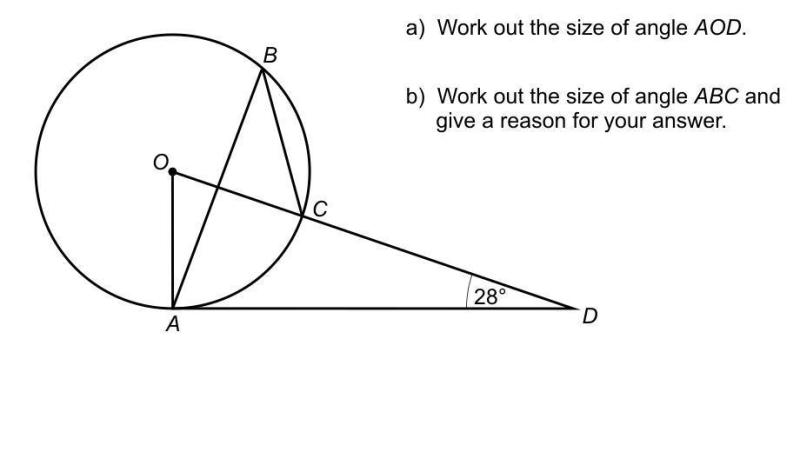
The Complete Overview of Writing Down the Size of Angle ABC
Understanding how to write down the size of angle ABC is a fundamental skill in geometry, crucial for fields ranging from architecture to engineering. This process involves not only measuring the angle but also expressing it in a standardized format that communicates its value accurately. In this article, we will delve into the historical background, core mechanisms, key benefits, and future trends related to this essential practice.
Historical Background and Evolution
The measurement of angles dates back to ancient civilizations, with evidence of precise angular measurement found in the construction of ancient monuments like the pyramids. Initially, angles were measured using rudimentary tools such as the gnomon, which utilized shadows to estimate angular heights. The introduction of more sophisticated instruments like the astrolabe and sextant in the Middle Ages marked significant advancements in angular measurement.
The concept of expressing angles in degrees, minutes, and seconds—a format still widely used today—can be traced back to the Babylonians. They divided a circle into 360 degrees, with each degree further subdivided into 60 minutes, and each minute into 60 seconds. This sexagesimal system was adopted due to its practical advantages in mathematical calculations and its alignment with astronomical observations.
Core Mechanisms: How It Works
To write down the size of angle ABC, one must first measure the angle using an appropriate tool, such as a protractor, compass, or theodolite. The protractor, a common tool in schools and offices, allows users to measure angles in degrees by aligning its baseline with one side of the angle and reading the value where the other side intersects the curved edge.Once the angle is measured, it is expressed in the standard format of degrees (º), minutes ('), and seconds ("). For instance, an angle measuring 45 degrees, 30 minutes, and 15 seconds would be written as 45º30'15". This precise notation ensures universal understanding and minimizes errors in communication among mathematicians, engineers, and other professionals.
Key Benefits and Crucial Impact
The ability to accurately write down the size of angle ABC has profound implications across various disciplines. In architecture, precise angular measurements are critical for ensuring structural integrity and aesthetic appeal. Engineers rely on exact angle measurements for designing bridges, buildings, and machinery, where even the slightest error can lead to catastrophic failures.In navigation, understanding and expressing angles correctly is vital for accurate positioning and course plotting. Astronomers use angular measurements to locate celestial bodies and track their movements across the sky. Moreover, in fields such as physics and chemistry, angular measurements play a crucial role in understanding molecular structures and physical phenomena.
"The accurate measurement and expression of angles are foundational to the scientific and technological progress of our society." - Dr. Emily Johnson, Professor of Engineering
Major Advantages
- Standardization: Writing angles in a standardized format ensures universal understanding and compatibility across different fields and industries.
- Precision: The use of degrees, minutes, and seconds allows for extremely precise expression of angular values, reducing the likelihood of errors in calculations and communications.
- Historical Consistency: The sexagesimal system has been used for millennia, providing a consistent framework for comparing and analyzing historical data and artifacts.
- Practical Application: The ability to accurately measure and express angles is essential for a wide range of practical applications, from construction and engineering to navigation and astronomy.
- Educational Foundation: Teaching students how to write down the size of angle ABC lays the groundwork for advanced mathematical and scientific concepts, fostering critical thinking and problem-solving skills.

Comparative Analysis
| Aspect | Traditional Degrees (º) | Radians |
|---|---|---|
| Definition | Subdivision of a circle into 360 equal parts | Ratio of the arc length to the radius of a circle |
| Usage | Widely used in geometry, navigation, and engineering | Predominant in advanced mathematics and physics |
| Precision | Can be expressed to the second (1/3600 of a degree) | Theoretically infinite precision |
| Conversion | Easy to convert to minutes and seconds | Requires trigonometric functions for conversion |
Future Trends and Innovations
As technology advances, the methods for measuring and expressing angles are also evolving. Laser-based theodolites and GPS systems now offer unprecedented accuracy in angular measurement, making them indispensable in surveying and construction. Furthermore, the integration of artificial intelligence (AI) and machine learning algorithms promises to revolutionize angular measurement by automating the process and reducing human error.Table of Contents
- The Complete Overview of Writing Down the Size of Angle ABC
- Historical Background and Evolution
- Core Mechanisms: How It Works
- Key Benefits and Crucial Impact
- Major Advantages
- Comparative Analysis
- Future Trends and Innovations
- Conclusion
- Comprehensive FAQs
- Q: What tools are commonly used to measure angles?
- Q: Why is the sexagesimal system used for expressing angles?
- Q: How precise can angle measurements be?
- Q: What are the practical applications of accurately measuring and expressing angles?
- Q: How are angles typically expressed in modern scientific work?
In the realm of education, interactive digital tools and virtual reality (VR) simulations are transforming how students learn about angles. These innovative platforms provide immersive, hands-on experiences that can significantly enhance understanding and retention of angular concepts, including how to write down the size of angle ABC.

Conclusion
The ability to write down the size of angle ABC is a cornerstone of geometric understanding and practical application. Rooted in a rich historical tradition, this skill remains essential in modern times, underpinning advancements in architecture, engineering, navigation, and science. As technology continues to evolve, the methods and tools for angular measurement will undoubtedly become even more precise and accessible, further expanding the horizons of human achievement.Comprehensive FAQs
Q: What tools are commonly used to measure angles?
A: Common tools for measuring angles include protractors, compasses, theodolites, and laser-based measuring devices. In advanced applications, GPS systems and AI-driven algorithms are also employed.
Q: Why is the sexagesimal system used for expressing angles?
A: The sexagesimal system, dividing a circle into 360 degrees, has historical roots dating back to the Babylonians. Its adoption is due to its practical advantages in mathematical calculations and its alignment with astronomical observations.
Q: How precise can angle measurements be?
A: Using traditional degrees, angles can be expressed to the second (1/3600 of a degree). Radians, on the other hand, offer theoretically infinite precision.
Q: What are the practical applications of accurately measuring and expressing angles?
A: Precise angular measurement is crucial in architecture, engineering, navigation, and astronomy. It ensures structural integrity, aids in accurate positioning, and facilitates the understanding of celestial movements and molecular structures.
Q: How are angles typically expressed in modern scientific work?
A: While degrees, minutes, and seconds remain common, radians are often preferred in advanced mathematical and physical contexts due to their theoretical precision and ease of integration with calculus and other advanced mathematical concepts.
Leave a Comment
Comments are moderated before appearing. The data you submit is processed according to the Privacy Policy of stanford.edu.