Unraveling the Mystery: What is the Range of the Function Below?
Understanding the range of a function is a fundamental concept in mathematics, crucial for various applications in science, engineering, and economics. The range of a function represents the set of all possible output values that the function can produce. This article aims to provide a comprehensive overview of what is the range of the function below, its historical background, core mechanisms, benefits, and future trends.
In the context of mathematical functions, the range is a vital component that helps us comprehend the function's behavior and predict its output. Whether you're dealing with linear, quadratic, or complex functions, knowing how to determine and interpret the range is essential. This article will guide you through the process, offering insights into the evolution of function theory, the mechanics of range determination, and the practical applications of this knowledge.
Moreover, we will explore the benefits of understanding function ranges, including improved data analysis, better decision-making, and enhanced problem-solving skills. We will also compare different functions based on their ranges and discuss how technological advancements are shaping the future of function analysis. By the end of this article, you should have a clear understanding of what is the range of the function below and its significance in various fields.

The Complete Overview of Function Range
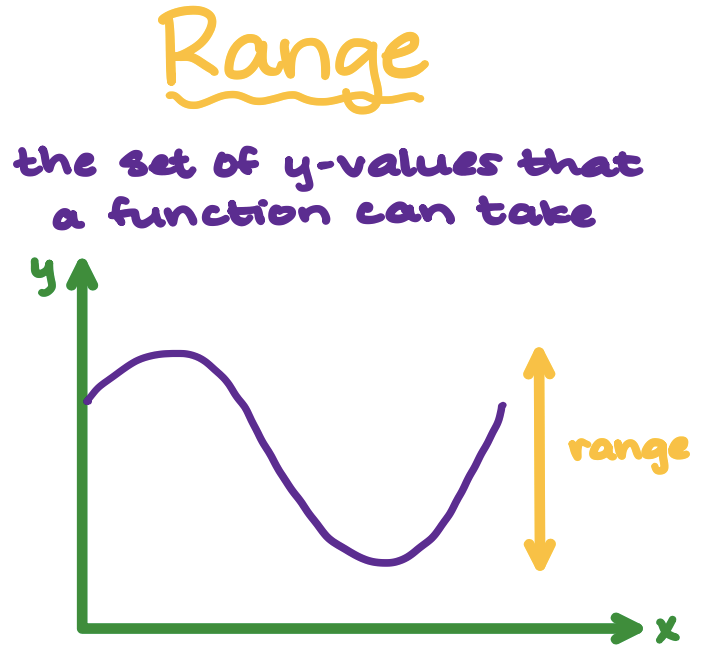
The range of a function is a fundamental concept in mathematics that describes the set of all possible output values, or y-values, that a function can produce. It is distinct from the domain, which represents the set of input values, or x-values, for which the function is defined. Understanding the range of a function is crucial for predicting its behavior, identifying its limits, and applying it in real-world scenarios.
Mathematicians and scientists have studied functions and their ranges for centuries, developing sophisticated methods to analyze and interpret them. From the basic linear functions encountered in elementary mathematics to the complex, multivariable functions used in advanced physics and engineering, the concept of range remains a cornerstone of mathematical analysis. This overview will delve into the historical background and evolution of function theory, as well as the core mechanisms behind determining the range of a function.
Historical Background and Evolution
The study of functions and their ranges dates back to ancient Greek mathematics, with significant contributions from mathematicians such as Euclid and Archimedes. However, the formal definition and systematic study of functions as we know them today began in the 17th and 18th centuries, with the development of calculus by Isaac Newton and Gottfried Wilhelm Leibniz. This period marked the beginning of a more rigorous and comprehensive approach to function analysis.
Table of Contents
- The Complete Overview of Function Range
- Historical Background and Evolution
- Core Mechanisms: How It Works
- Key Benefits and Crucial Impact
- Major Advantages
- Comparative Analysis
- Future Trends and Innovations
- Conclusion
- Comprehensive FAQs
- Q: What is the difference between the domain and range of a function?
- Q: How do I find the range of a linear function?
- Q: What is the range of a quadratic function?
- Q: Can a function have an empty range?
- Q: How does understanding the range of a function benefit real-world applications?
In the 19th century, mathematicians like Carl Friedrich Gauss and Bernhard Riemann further expanded the theory of functions, introducing concepts such as complex analysis and Riemann surfaces. These advancements allowed for a deeper understanding of functions with complex inputs and outputs, significantly broadening the scope of function analysis. The 20th century saw the development of set theory and the formalization of the domain and range of functions, providing a more precise framework for mathematical analysis.
Core Mechanisms: How It Works
Determining the range of a function involves several core mechanisms and techniques. The first step is to identify the domain of the function, as the range is dependent on the input values that the function accepts. Once the domain is established, mathematicians use various methods to analyze the function's behavior, such as graphing, algebraic manipulation, and the application of mathematical theorems.
Graphing is a powerful tool for visualizing the range of a function. By plotting the function on a coordinate plane, one can observe the set of y-values that the function attains. Algebraic manipulation involves applying mathematical operations to the function's equation to express it in a form that reveals the range. For example, rearranging a quadratic function to complete the square can help identify the vertex and determine the range.
Key Benefits and Crucial Impact
Understanding the range of a function has significant benefits across various fields. In mathematics, it enables deeper insights into function behavior, facilitates proof construction, and aids in the development of new mathematical theories. In the sciences, knowledge of function ranges is essential for modeling natural phenomena, predicting outcomes, and making informed decisions.
"The range of a function is the set of all possible output values, and it provides a crucial context for understanding how a function behaves and what kinds of values it can produce."
Major Advantages
- Enhanced Problem-Solving: Knowing the range of a function allows mathematicians and scientists to solve problems more effectively by predicting possible outcomes and identifying constraints.
- Improved Data Analysis: In data analysis, understanding the range of a function helps in interpreting data, identifying trends, and making accurate predictions.
- Better Decision-Making: Functions are often used to model real-world situations, and knowing their range aids in making informed decisions by considering all possible outcomes.
- Optimization: The range of a function is crucial in optimization problems, where the goal is to find the best possible solution within a given set of constraints.
- Theoretical Advancements: In pure mathematics, studying the range of functions contributes to the development of new theories and the advancement of mathematical knowledge.
Comparative Analysis
| Function Type | Range Characteristics |
|---|---|
| Linear Functions | The range is either all real numbers or a closed interval, depending on the slope and y-intercept. |
| Quadratic Functions | The range is either all real numbers or a closed interval, determined by the vertex and the leading coefficient. |
| Exponential Functions | The range is always positive real numbers, as exponential functions grow rapidly and never reach zero. |
| Logarithmic Functions | The range is all real numbers greater than zero, due to the nature of logarithms and their relationship with exponential functions. |
Future Trends and Innovations
As technology advances, the field of function analysis continues to evolve. Computer algebra systems and advanced graphing software have made it easier than ever to visualize and analyze functions, enabling mathematicians and scientists to explore complex functions and their ranges with greater efficiency. Moreover, the growing field of data science relies heavily on function analysis for modeling and predicting trends in large datasets.
In the future, we can expect further developments in computational methods for function analysis, as well as new theoretical advancements driven by the need to solve complex problems in fields such as machine learning, artificial intelligence, and quantum physics. The concept of what is the range of the function below will remain a fundamental question, driving innovation and discovery in mathematics and beyond.

Conclusion
In conclusion, understanding the range of a function is a crucial aspect of mathematical analysis with wide-ranging applications. From its historical roots in ancient Greek mathematics to its modern-day role in advanced scientific modeling, the concept of function range has evolved and expanded, providing valuable insights into function behavior and enabling better decision-making across disciplines.
As we look to the future, continued advancements in technology and computational methods will further enhance our ability to analyze and interpret functions and their ranges. Whether you are a student, a researcher, or a professional in a field that relies on mathematical modeling, grasping the concept of what is the range of the function below is essential for success and innovation.
Comprehensive FAQs
Q: What is the difference between the domain and range of a function?
A: The domain of a function is the set of all possible input values (x-values) for which the function is defined. In contrast, the range is the set of all possible output values (y-values) that the function can produce.
Q: How do I find the range of a linear function?
A: For a linear function in the form y = mx + b, the range is either all real numbers (if the slope m is non-zero) or a closed interval defined by the y-intercept (if m = 0).
Q: What is the range of a quadratic function?
A: The range of a quadratic function in the form y = ax^2 + bx + c depends on the value of the leading coefficient a. If a > 0, the range is all real numbers greater than or equal to the vertex's y-value. If a < 0, the range is all real numbers less than or equal to the vertex's y-value.
Q: Can a function have an empty range?
A: No, a function cannot have an empty range. By definition, a function maps each input value in the domain to at least one output value in the range. Therefore, the range of a function is always non-empty.
Q: How does understanding the range of a function benefit real-world applications?
A: Knowing the range of a function is crucial in real-world applications as it helps in predicting possible outcomes, identifying constraints, and making informed decisions. For example, in economics, understanding the range of a demand function can help businesses set optimal prices, while in physics, knowing the range of a velocity function can aid in designing safe and efficient systems.
Leave a Comment
Comments are moderated before appearing. The data you submit is processed according to the Privacy Policy of stanford.edu.