Unveiling the Geometry: What is the Volume of a Sphere?
The volume of a sphere is a fundamental concept in geometry, representing the amount of space enclosed within this three-dimensional shape. This seemingly simple yet elegant form has captivated mathematicians, scientists, and engineers for centuries. In this article, we will embark on a journey to understand the volume of a sphere, its historical significance, and its wide-ranging applications in various fields.
From ancient architectural marvels to modern technological advancements, the sphere's unique properties have left an indelible mark on human civilization. By delving into the intricacies of its volume calculation, we uncover a profound understanding of this timeless geometric figure.
Whether you're an academic enthusiast, a student grappling with mathematical concepts, or a professional seeking practical insights, this comprehensive exploration will provide valuable insights into the world of spherical geometry.

The Complete Overview of Spherical Volume
A sphere is a perfectly round, three-dimensional object where every point on its surface is equidistant from its center. This inherent symmetry and simplicity have made it a subject of fascination and study since ancient times. Calculating the volume of a sphere involves determining the amount of space it occupies, a task that has intrigued mathematicians for centuries.
The volume of a sphere is directly related to its radius, a measure of the distance from the center to any point on its surface. This relationship is expressed through a mathematical formula, providing a precise method to calculate the volume for spheres of any size. Understanding this formula and its underlying principles is key to grasping the concept of spherical volume.
Historical Background and Evolution
The study of spheres and their properties dates back to ancient Greek mathematics. Mathematicians such as Euclid and Archimedes made significant contributions to our understanding of spherical geometry. Archimedes, in particular, is renowned for his work on the volume of a sphere, developing a method to calculate it using intricate geometric proofs.
Table of Contents
- The Complete Overview of Spherical Volume
- Historical Background and Evolution
- Core Mechanisms: How Spherical Volume Works
- Key Benefits and Crucial Impact
- Major Advantages
- Comparative Analysis
- Future Trends and Innovations
- Conclusion
- Comprehensive FAQs
- Q: What is the formula for the volume of a sphere?
- Q: How does the volume of a sphere relate to its radius?
- Q: Can you explain the historical significance of Archimedes' work on spherical volume?
- Q: What are some practical applications of understanding the volume of a sphere?
- Q: How does the volume of a sphere compare to other common 3D shapes?
In his treatise On the Sphere and Cylinder, Archimedes demonstrated that the volume of a sphere is two-thirds of the volume of the cylinder that circumscribes it. This brilliant insight laid the foundation for modern volume calculations and highlighted the sphere's unique and efficient use of space. Over the centuries, mathematicians refined and expanded upon Archimedes' work, leading to the development of more sophisticated formulas and techniques.
Core Mechanisms: How Spherical Volume Works
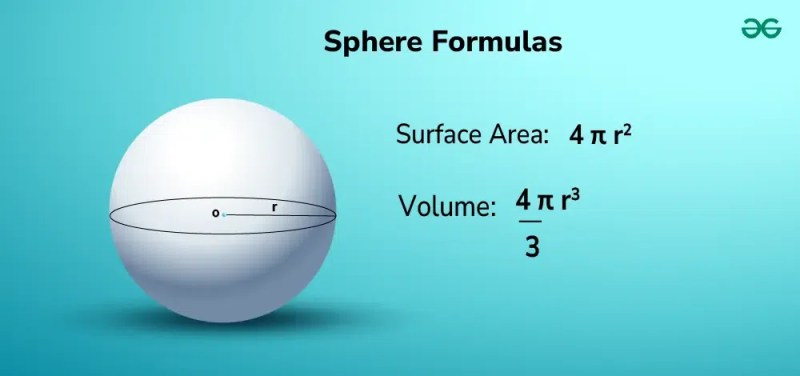
At the heart of understanding the volume of a sphere is the formula: V = (4/3)πr³, where V represents the volume and r is the radius of the sphere. This formula is derived from the integration of infinitesimally small disks that make up the sphere, each with a thickness of dx and a radius of r - x. By integrating these disks from the center to the surface, mathematicians arrive at the definitive volume formula.
The use of calculus and integral calculus, in particular, is instrumental in deriving this formula. It allows us to calculate the volume by summing the volumes of an infinite number of infinitesimally thin disks, each contributing to the overall shape. This mathematical approach not only provides an accurate method for volume calculation but also highlights the intricate relationship between the sphere's dimensions and its enclosed space.
Key Benefits and Crucial Impact
The concept of spherical volume has far-reaching implications and benefits across various disciplines. Its significance lies not only in theoretical mathematics but also in practical applications that shape our daily lives.
"The sphere is the most efficient shape for enclosing a given volume. Its unique geometry minimizes surface area for a given volume, making it a cornerstone in fields ranging from architecture to aerospace engineering."
Major Advantages
- Structural Integrity: Spheres exhibit exceptional structural strength and stability. Their uniform distribution of mass and lack of corners or edges make them resistant to external forces, an essential property in engineering and architecture.
- Efficient Use of Materials: The volume-to-surface area ratio of a sphere is optimal. This means that for a given volume, a sphere requires the least amount of material to enclose it, leading to cost savings and resource efficiency in manufacturing and construction.
- Fluid Dynamics: In fluid mechanics, spheres have unique properties. They experience minimal drag when moving through fluids, making them ideal for applications such as ball bearings and aerodynamic designs.
- Astronomy and Astrophysics: The volume of celestial bodies, such as planets and stars, is often modeled using spherical geometry. Understanding the volume of spheres is crucial for studying the universe and predicting the behavior of celestial objects.
- Computer Graphics and Gaming: In the digital realm, spheres are fundamental shapes used in 3D modeling and computer graphics. Their simple geometry and well-defined volume make them easy to render and manipulate, contributing to realistic visual effects in movies and video games.
Comparative Analysis
| Shape | Volume Formula | Surface Area | Key Applications |
|---|---|---|---|
| Sphere | V = (4/3)πr³ | A = 4πr² | Engineering, Architecture, Astronomy |
| Cube | V = s³ | A = 6s² | Packaging, Construction, Game Dice |
| Cylinder | V = πr²h | A = 2πrh + 2πr² | Structural Design, Containers, Pipes |
| Cone | V = (1/3)πr²h | A = πr² + πrs | Funneling, Structural Elements, Traffic Cones |
Future Trends and Innovations
As technology advances and our understanding of the natural world deepens, the volume of a sphere continues to play a pivotal role in shaping the future. In the realm of materials science, researchers are exploring novel applications of spherical geometry in nanotechnology and advanced manufacturing.
The development of spherical nanoparticles, for instance, holds promise in medicine for targeted drug delivery and imaging. Additionally, 3D printing and additive manufacturing techniques are enabling the creation of complex spherical structures, opening new possibilities in architecture and product design. These innovations showcase the enduring relevance and applicability of spherical volume in modern scientific and technological advancements.

Conclusion
The volume of a sphere is more than just a mathematical concept; it is a fundamental principle that underpins numerous aspects of our physical world. From ancient architectural wonders to cutting-edge technological innovations, the sphere's unique properties have left an indelible mark on human civilization.
Through this exploration, we have uncovered the historical significance, mathematical intricacies, and practical applications of spherical volume. As we continue to push the boundaries of science and technology, the sphere's elegant geometry and efficient use of space will undoubtedly inspire new discoveries and innovations, further cementing its place in the fabric of human knowledge.
Comprehensive FAQs
Q: What is the formula for the volume of a sphere?
A: The formula for the volume of a sphere is V = (4/3)πr³, where V represents the volume and r is the radius of the sphere.
Q: How does the volume of a sphere relate to its radius?
A: The volume of a sphere is directly proportional to the cube of its radius. This means that if you double the radius, the volume will increase by a factor of 2³ (8 times). This relationship is expressed in the formula V = (4/3)πr³.
Q: Can you explain the historical significance of Archimedes' work on spherical volume?
A: Archimedes' work on the volume of a sphere, as presented in his treatise On the Sphere and Cylinder, was groundbreaking. He demonstrated that the volume of a sphere is two-thirds of the volume of the circumscribing cylinder. This discovery provided a solid foundation for modern volume calculations and highlighted the sphere's efficient use of space.
Q: What are some practical applications of understanding the volume of a sphere?
A: Understanding the volume of a sphere has numerous practical applications. In engineering, it aids in designing structurally sound and efficient components. In architecture, it informs the construction of stable and aesthetically pleasing structures. Additionally, it is crucial in fields such as astronomy, fluid dynamics, and computer graphics, where spherical geometry plays a significant role.
Q: How does the volume of a sphere compare to other common 3D shapes?
A: Compared to other common 3D shapes, the sphere has a unique volume-to-surface area ratio. It encloses the maximum volume for a given surface area, making it the most efficient shape for certain applications. This is evident when comparing it to shapes like cubes, cylinders, and cones, each with distinct volume and surface area formulas and applications.
Leave a Comment
Comments are moderated before appearing. The data you submit is processed according to the Privacy Policy of stanford.edu.