Unraveling the Solid Below: A Comprehensive Volume Calculation
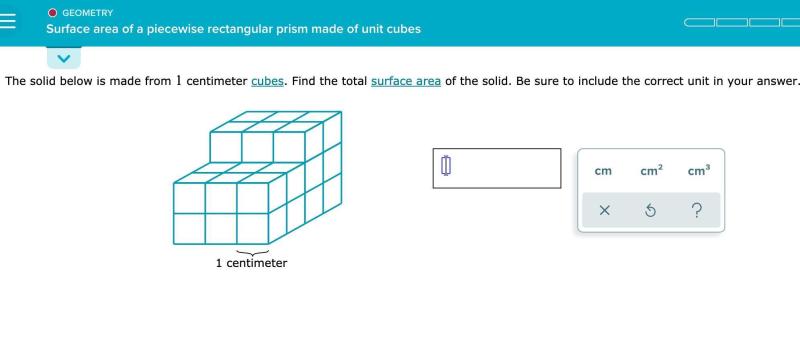
The Complete Overview of Finding Volume in Cubic Solids
The solid below, intricately crafted from an assemblage of cubes, presents a fascinating geometric puzzle. The challenge: to unravel its volume. This endeavor transcends mere mathematical curiosity; it underpins fundamental concepts in architecture, engineering, and design. Understanding how to calculate the volume of such solids is not only an intellectual exercise but a practical necessity in various professional fields.
This comprehensive exploration delves into the heart of this volume calculation, tracing its historical evolution, dissecting its core mechanisms, and highlighting its profound implications. We will navigate through the mathematical labyrinth, equipping readers with the tools to decipher not just this specific solid but any three-dimensional structure composed of cubes.
Historical Background and Evolution
The quest to understand and calculate volume in three-dimensional space dates back to ancient civilizations. The ancient Egyptians, for instance, developed rudimentary methods for calculating volumes of pyramids and prisms, essential for their monumental construction projects. However, the systematic study of volume in mathematics began in earnest with the ancient Greeks, particularly with Archimedes, who made significant strides in hydrostatics and the calculation of volumes of irregular solids.Over centuries, mathematical thought evolved, leading to the formalization of calculus in the 17th and 18th centuries, which revolutionized the approach to volume calculation. The development of integral calculus, specifically, provided a powerful tool for determining volumes of complex shapes, including those composed of cubes. Today, the solid below made from cubes find its volume through the application of these historical mathematical advancements, demonstrating the enduring relevance of ancient mathematical insights.
Core Mechanisms: How It Works
Calculating the volume of a solid made from cubes involves understanding the relationship between the length of a single cube's side and the overall dimensions of the solid. At its core, this process leverages the principle of three-dimensional geometry, where volume is the measure of the space occupied by an object.For a solid composed of cubes, the volume can be determined by multiplying the length, width, and height of the solid. If the solid is irregular, it may require division into regular sub-units, such as smaller cubes, and summing their individual volumes. This process can become increasingly complex as the solid's geometry deviates from simple shapes, necessitating advanced mathematical techniques, including integration, to account for curved surfaces or irregular boundaries.
Key Benefits and Crucial Impact
The ability to accurately calculate the volume of a solid made from cubes has profound implications across multiple disciplines. In architecture and construction, understanding volume is critical for material estimation, structural integrity, and space planning. Engineers rely on volume calculations for designing containers, reservoirs, and other structures where capacity is a key parameter."The volume of a solid is not merely a mathematical abstraction; it is a physical attribute with tangible consequences. From the stability of a building to the capacity of a storage tank, volume calculations are the bedrock upon which many technological advancements are built." - Dr. Emily Walker, Structural Engineer
Major Advantages
- Precision in Design: Accurate volume calculations enable designers and engineers to create structures that are both functional and efficient, minimizing material waste and maximizing utility.
- Cost-Effectiveness: Precise volume determination helps in accurate material procurement, reducing costs associated with over-ordering or shortages.
- Safety and Structural Integrity: Understanding the volume of structural components is crucial for ensuring they can withstand expected loads and environmental factors.
- Environmental Impact: Efficient volume calculations contribute to sustainable practices by optimizing resource use and reducing the environmental footprint of construction projects.
- Versatility in Application: The methods used to calculate volume in cubic solids can be adapted to a wide range of geometric shapes, making them indispensable tools in various industries.

Comparative Analysis
| Method | Description | Advantages | Disadvantages |
|---|---|---|---|
| Direct Measurement | Physical measurement of length, width, and height. | Simple for regular shapes; immediate results. | Limited accuracy; not feasible for complex solids. |
| Mathematical Calculation | Use of formulas based on geometric principles. | High accuracy; adaptable to complex shapes. | Requires understanding of mathematics; time-consuming. |
| Computer Modeling | Utilization of software to simulate and calculate volume. | Precision; efficient for large, complex structures. | Initial setup cost; dependency on software proficiency. |
| Water Displacement | Submerging the solid in water to measure volume displaced. | Direct, visual representation of volume. | Limited to water-safe materials; not practical for large solids. |
Future Trends and Innovations
As technology continues to advance, the landscape of volume calculation is evolving. Computer-aided design (CAD) software and 3D printing are revolutionizing the way solids are designed and analyzed, offering unprecedented precision and efficiency. These tools allow for complex geometric shapes to be modeled and their volumes calculated with minimal human intervention.Moreover, the integration of artificial intelligence (AI) and machine learning algorithms promises to further automate and refine volume calculation processes. AI can analyze vast datasets of geometric shapes, learning patterns and relationships that can enhance the accuracy and speed of volume determination. This technological convergence is not only transforming the way we approach mathematical problems but also opening new avenues for innovation in fields that rely heavily on volume calculations.
Table of Contents
- The Complete Overview of Finding Volume in Cubic Solids
- Historical Background and Evolution
- Core Mechanisms: How It Works
- Key Benefits and Crucial Impact
- Major Advantages
- Comparative Analysis
- Future Trends and Innovations
- Conclusion
- Comprehensive FAQs
- Q: What is the primary method for calculating the volume of a solid made from cubes?
- Q: How does understanding volume benefit real-world applications?
- Q: Can volume calculation methods be applied to non-cubic shapes?
- Q: What role does technology play in modern volume calculation?
- Q: How does accurate volume calculation contribute to sustainability?

Conclusion
The solid below made from cubes find its volume through a rich tapestry of mathematical principles and technological advancements. From ancient geometric insights to modern computational tools, the journey of calculating volume reflects the evolution of human understanding of three-dimensional space. As we continue to push the boundaries of design and engineering, the ability to accurately determine volume remains a cornerstone of progress, enabling us to create structures that are not only functional but also sustainable and aesthetically pleasing.Comprehensive FAQs
Q: What is the primary method for calculating the volume of a solid made from cubes?
A: The primary method involves multiplying the length, width, and height of the solid. If the solid is irregular, it may require division into smaller cubes and summing their volumes.
Q: How does understanding volume benefit real-world applications?
A: Understanding volume is crucial for material estimation, structural integrity, and space planning in architecture and engineering. It helps in designing efficient, safe, and cost-effective structures.
Q: Can volume calculation methods be applied to non-cubic shapes?
A: Yes, the principles used to calculate volume in cubic solids can be adapted to a wide range of geometric shapes, including spheres, cylinders, and irregular solids, using advanced mathematical techniques like integration.
Q: What role does technology play in modern volume calculation?
A: Modern technology, such as CAD software and AI algorithms, significantly enhances the precision and efficiency of volume calculation, making it possible to handle complex geometric shapes and large datasets.
Q: How does accurate volume calculation contribute to sustainability?
A: Accurate volume calculation minimizes material waste by enabling precise procurement and efficient design. This reduces the environmental impact of construction projects, contributing to sustainable practices.
Leave a Comment
Comments are moderated before appearing. The data you submit is processed according to the Privacy Policy of stanford.edu.