Is a Triple Bond 2 Pi Bonds? Unraveling the Chemical Bonding Mystery
Chemical bonding is a fundamental concept in chemistry that explains how atoms come together to form molecules. One of the most intriguing aspects of this field is the nature of triple bonds. The question "Is a triple bond 2 pi bonds?" has intrigued students and scientists alike. This article aims to provide a comprehensive overview of this topic, delving into the historical background, core mechanisms, benefits, and future trends.
In the realm of molecular interactions, the strength and type of bonds significantly influence the properties and behavior of substances. Triple bonds, found in molecules like nitrogen gas (N2), are known for their exceptional stability. Understanding their composition—whether they indeed consist of 2 pi bonds—is crucial for grasping the intricacies of chemical bonding.
This deep dive will not only clarify the structure of triple bonds but also explore how they compare to other types of bonds. By the end, you'll have a profound understanding of why triple bonds are unique and how they contribute to the fascinating world of chemistry.

The Complete Overview of Triple Bonds and Pi Bonds
Chemical bonds are the glue that holds atoms together in molecules. They result from the electrostatic forces of attraction between the positively charged nucleus of one atom and the negatively charged electrons of another. Among the various types of chemical bonds, triple bonds stand out for their strength and stability.
A triple bond, as the name suggests, involves the sharing of three electron pairs between two atoms. This bond is stronger and shorter than a single or double bond. It is characterized by the presence of both sigma (σ) and pi (π) bonds. The question "Is a triple bond 2 pi bonds?" arises from the observation that pi bonds are crucial components of triple bonds.
Historical Background and Evolution
The concept of chemical bonding dates back to the early 20th century when scientists like Gilbert N. Lewis and Irving Langmuir developed the theory of electron pair sharing. Lewis introduced the idea of electron dot structures in 1916, which laid the foundation for understanding bond formation. Langmuir later expanded on this work, coining the term "covalent bond" and describing the role of electron pairs in bonding.
Table of Contents
- The Complete Overview of Triple Bonds and Pi Bonds
- Historical Background and Evolution
- Core Mechanisms: How Triple Bonds Work
- Key Benefits and Crucial Impact
- Major Advantages
- Comparative Analysis
- Future Trends and Innovations
- Conclusion
- Comprehensive FAQs
- Q: What is a triple bond in chemistry?
- Q: How does a triple bond differ from a single or double bond?
- Q: Are there any biological molecules that contain triple bonds?
- Q: Can triple bonds exist between any two elements?
- Q: What is the significance of pi bonds in a triple bond?
The distinction between sigma and pi bonds emerged as scientists sought to explain the molecular structure of more complex molecules. In the 1930s, Linus Pauling and others developed the concept of hybrid orbitals, which helped clarify the geometry and strength of different types of bonds. The understanding of triple bonds as consisting of one sigma and two pi bonds solidified during this period.
Core Mechanisms: How Triple Bonds Work
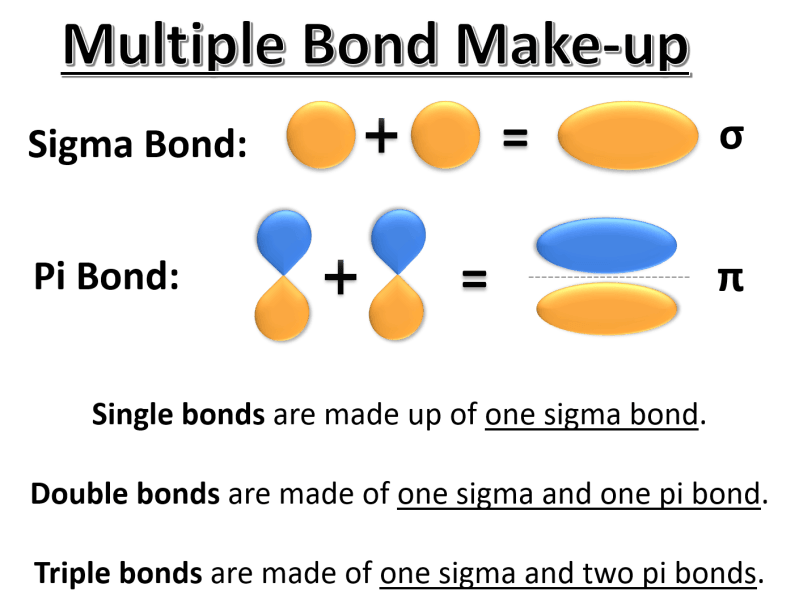
Triple bonds form when two atoms share three pairs of electrons. This sharing involves the overlap of atomic orbitals, creating regions of high electron density between the nuclei of the bonded atoms. The bond consists of two distinct types of bonds: sigma (σ) and pi (π) bonds.
Sigma bonds result from the head-to-head overlap of orbitals, allowing for the maximum sharing of electron density. Pi bonds, on the other hand, arise from the side-to-side overlap of orbitals, creating a nodal plane where electron density is zero. A triple bond comprises one sigma bond and two pi bonds, arranged in a linear geometry.
Key Benefits and Crucial Impact
The unique structure of triple bonds confers several advantages, making them essential in various chemical and biological processes.
"Triple bonds are nature's way of creating some of the strongest and most stable molecules, which are fundamental to life and industry."
Major Advantages
- Exceptional Strength: Triple bonds are approximately 10% stronger than double bonds and significantly stronger than single bonds. This strength contributes to the stability of molecules like nitrogen gas (N2) and carbon monoxide (CO).
- Short Bond Length: The compact nature of triple bonds results in shorter distances between the bonded atoms, leading to increased stability and reduced steric hindrance.
- Linear Geometry: The arrangement of sigma and pi bonds in a triple bond enforces a linear molecular geometry, which is crucial for the specific shape and function of certain molecules.
- Stability in Various Conditions: Molecules with triple bonds exhibit remarkable stability across a wide range of temperatures and pressures, making them resistant to decomposition.
- Biological Significance: Triple bonds play vital roles in biological molecules, such as the peptide bonds in proteins, which are essential for life processes.
Comparative Analysis
| Bond Type | Bond Strength | Bond Length | Geometry |
|---|---|---|---|
| Single Bond | Weakest | Longest | Variable |
| Double Bond | Stronger than single | Shorter than single | Linear or Bent |
| Triple Bond | Strongest | Shortest | Linear |
| Quadruple Bond | Theoretical, even stronger | Hypothetically shorter | Linear |
Future Trends and Innovations
As our understanding of chemical bonding continues to evolve, new applications and discoveries are on the horizon. Researchers are exploring the potential of quadruple bonds, which are predicted to be even stronger and shorter than triple bonds. These exotic bonds could lead to the development of novel materials with unprecedented properties.
Moreover, advancements in computational chemistry and quantum mechanics are providing deeper insights into the nature of chemical bonds. These tools are helping scientists design new molecules with tailored bond types and strengths, opening up possibilities in fields such as pharmaceuticals, materials science, and catalysis.

Conclusion
The question "Is a triple bond 2 pi bonds?" highlights the intricate and fascinating world of chemical bonding. Indeed, triple bonds consist of one sigma and two pi bonds, resulting in an exceptionally strong and stable bond. Understanding this structure is crucial for comprehending the behavior and properties of numerous molecules essential to life and industry.
As we continue to unravel the mysteries of chemical bonding, new discoveries and applications will undoubtedly emerge, shaping the future of science and technology. The fundamental concept of triple bonds remains a cornerstone in our understanding of molecular interactions.
Comprehensive FAQs
Q: What is a triple bond in chemistry?
A: A triple bond is a type of chemical bond that involves the sharing of three electron pairs between two atoms. It consists of one sigma (σ) bond and two pi (π) bonds, arranged in a linear geometry.
Q: How does a triple bond differ from a single or double bond?
A: Triple bonds are stronger and shorter than single or double bonds. They provide greater stability to molecules and enforce a linear molecular geometry. Single bonds are the weakest and longest, while double bonds are intermediate in strength and length.
Q: Are there any biological molecules that contain triple bonds?
A: Yes, several biological molecules contain triple bonds. One notable example is the peptide bond in proteins, which is a triple bond between the carbonyl carbon of one amino acid and the nitrogen of another. This bond is crucial for the formation of protein chains.
Q: Can triple bonds exist between any two elements?
A: Triple bonds are most commonly found between atoms of similar electronegativity and size. Elements in the same group of the periodic table, such as nitrogen (N) and carbon (C), often form triple bonds. However, under certain conditions, triple bonds can also be observed between other elements.
Q: What is the significance of pi bonds in a triple bond?
A: Pi bonds are crucial for the stability and strength of triple bonds. They arise from the side-to-side overlap of orbitals, creating additional regions of electron density between the bonded atoms. The presence of two pi bonds in a triple bond contributes to its exceptional stability.
Leave a Comment
Comments are moderated before appearing. The data you submit is processed according to the Privacy Policy of stanford.edu.