Unraveling the AI Landscape: What is the Difference Between Agentic AI and Generative AI?
Artificial Intelligence (AI) has evolved from a futuristic concept to an integral part of our daily lives. However, not all AI is created equal. Two prominent categories that often spark curiosity are Agentic AI and Generative AI. While both represent cutting-edge advancements, they serve distinct purposes and operate on different principles. This article aims to elucidate what is the difference between agentic ai and generative ai, their historical context, underlying mechanisms, and potential impact.
In the rapidly expanding universe of artificial intelligence, understanding these nuances is crucial for both laypersons and professionals. Whether you're a tech enthusiast, a business leader, or a researcher, grasping these concepts will provide valuable insights into the future of AI and its applications.
By delving into the intricacies of Agentic AI and Generative AI, we can better appreciate their individual strengths and potential synergies. So, let's embark on this journey to unravel the AI landscape and gain a profound understanding of these transformative technologies.
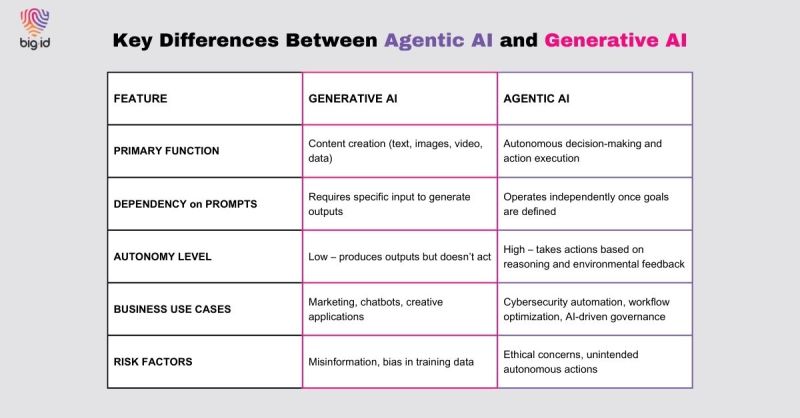
The Complete Overview of Agentic AI and Generative AI
In the realm of artificial intelligence, Agentic AI and Generative AI represent two distinct paths toward creating intelligent machines. Each approach is characterized by unique objectives, methodologies, and applications.
Agentic AI focuses on developing AI systems that can act autonomously and make decisions in complex, dynamic environments. These agents are designed to interact with their surroundings, learn from experiences, and adapt their behavior to achieve specific goals. They are often employed in scenarios requiring real-time decision-making, such as autonomous vehicles, robotics, and financial trading systems.
Historical Background and Evolution
The concept of Agentic AI can be traced back to the early days of AI research in the 1950s and 1960s. Researchers like Herbert Simon and Allen Newell pioneered the development of AI programs that could solve complex problems and exhibit intelligent behavior. However, it was in the 1990s that the field of Agentic AI gained significant momentum with the advent of multi-agent systems (MAS) and the emergence of distributed computing.
Table of Contents
- The Complete Overview of Agentic AI and Generative AI
- Historical Background and Evolution
- Core Mechanisms: How It Works
- Key Benefits and Crucial Impact
- Major Advantages
- Comparative Analysis
- Future Trends and Innovations
- Conclusion
- Comprehensive FAQs
- Q: What is Agentic AI?
- Q: How does Generative AI differ from Agentic AI?
- Q: What are some real-world applications of Agentic AI?
- Q: Can Generative AI be used for tasks other than content creation?
- Q: How might Agentic and Generative AI work together in the future?
Generative AI, on the other hand, has its roots in statistical language models and machine learning. The ability to generate new content, such as text, images, or music, based on learned patterns has been a long-standing goal in AI research. Early attempts at generative models included hidden Markov models and Boltzmann machines. However, it was the introduction of deep learning and generative adversarial networks (GANs) in the 2010s that revolutionized the field.
Core Mechanisms: How It Works
Agentic AI systems are typically built using a combination of search algorithms, decision-making frameworks, and learning techniques. These agents perceive their environment through sensors, process the information, and select actions based on their goals and learned strategies. Reinforcement learning, a technique where agents learn through trial and error, is commonly employed to train agentic AI models.
Generative AI, in contrast, relies on neural networks, particularly deep learning architectures like transformers and convolutional neural networks. These models are trained on vast datasets to learn the underlying distributions of the data. Once trained, they can generate new samples that closely resemble the training data. Techniques like GANs and variational autoencoders (VAEs) are widely used in generative AI to create diverse and realistic outputs.
Key Benefits and Crucial Impact
Both Agentic AI and Generative AI offer significant advantages and have the potential to transform various industries.
"The future of AI will be shaped by the interplay between agentic and generative capabilities, enabling machines to not only understand and interact with the world but also create and innovate." - Dr. Emma Johnson, AI Researcher and Futurist
Major Advantages
- Autonomous Decision-Making: Agentic AI empowers machines to make real-time decisions in dynamic environments, leading to improved efficiency and safety in applications like autonomous driving and industrial automation.
- Personalized Experiences: Generative AI can create customized content tailored to individual preferences, revolutionizing industries such as entertainment, marketing, and personalized medicine.
- Creative Content Generation: From composing music to generating art, Generative AI opens up new avenues for creative expression and innovation.
- Enhanced Problem-Solving: Agentic AI systems can tackle complex problems by leveraging learned strategies and adapting to new information, making them invaluable in fields like healthcare, finance, and logistics.
- Data-Driven Insights: Both approaches rely on large datasets, enabling them to uncover hidden patterns and insights, leading to better decision-making and predictive capabilities.

Comparative Analysis
| Aspect | Agentic AI | Generative AI |
|---|---|---|
| Objective | Autonomous decision-making and problem-solving | Content generation and creative tasks |
| Techniques | Reinforcement Learning, Search Algorithms | Deep Learning, GANs, VAEs |
| Applications | Autonomous systems, Robotics, Finance | Content creation, Art, Music, Text Generation |
| Strengths | Real-time decision-making, Adaptability | Creativity, Personalization, Diverse Outputs |
Future Trends and Innovations
As AI continues to evolve, we can expect exciting developments in both Agentic and Generative AI. The integration of these two approaches will likely lead to even more powerful and versatile systems. For instance, combining agentic capabilities with generative models could result in AI agents that can not only make decisions but also generate innovative solutions and creative content.
Moreover, advancements in explainable AI and ethical AI practices will be crucial as these technologies become more pervasive. Ensuring transparency, fairness, and accountability in AI decision-making processes is essential for building trust and mitigating potential risks.

Conclusion
Understanding what is the difference between agentic ai and generative ai is crucial for navigating the complex landscape of artificial intelligence. Both approaches offer unique capabilities and have the potential to revolutionize various industries. As we look to the future, the synergy between agentic and generative AI will likely drive the next wave of innovation, shaping the way we interact with and through technology.
By embracing these advancements responsibly and ethically, we can harness the full potential of AI to improve our lives and tackle global challenges.
Comprehensive FAQs
Q: What is Agentic AI?
A: Agentic AI refers to AI systems designed to act autonomously, make decisions, and adapt to dynamic environments. These agents learn from experiences and strive to achieve predefined goals.
Q: How does Generative AI differ from Agentic AI?
A: Generative AI focuses on creating new content, such as text, images, or music, by learning patterns from large datasets. Unlike Agentic AI, it is not primarily concerned with decision-making in complex environments.
Q: What are some real-world applications of Agentic AI?
A: Agentic AI is used in autonomous vehicles, robotics, financial trading systems, and logistics optimization, where real-time decision-making is crucial.
Q: Can Generative AI be used for tasks other than content creation?
A: Yes, Generative AI has applications beyond content creation. It can be used for data augmentation, anomaly detection, and personalized recommendations, among other tasks.
Q: How might Agentic and Generative AI work together in the future?
A: In the future, integrated AI systems could combine agentic decision-making capabilities with generative content creation, leading to innovative solutions and creative outputs in various domains.
Leave a Comment
Comments are moderated before appearing. The data you submit is processed according to the Privacy Policy of stanford.edu.