Unveiling the Versatility: What is Chromatography Used For?

Unveiling the Versatility: What is Chromatography Used For?
Chromatography stands as a cornerstone in the realm of analytical chemistry and beyond, offering a delicate dance between precision and insight. This powerful technique, with its roots firmly planted in the early 20th century, has evolved into an indispensable tool across a myriad of fields. From unraveling the complexities of environmental pollutants to deciphering the intricate profiles of pharmaceuticals, chromatography's utility is both profound and pervasive.
At its core, chromatography is a separation method that leverages the differential interactions of substances with a stationary phase and a mobile phase. This simple yet elegant principle allows for the identification, quantification, and purification of individual components within a complex mixture. As we delve deeper into the question of "what is chromatography used for?", a panorama of applications emerges, each testament to the technique's adaptability and significance.
Whether in the sterile confines of a pharmaceutical laboratory, the bustling environment of an environmental monitoring facility, or the cutting-edge research labs of academia, chromatography's impact is undeniable. It is a technique that has not only kept pace with scientific advancements but has often been the catalyst for groundbreaking discoveries. Join us as we explore the multifaceted world of chromatography, delving into its historical foundations, mechanistic intricacies, and the vast tapestry of industries it serves.
The Complete Overview of Chromatography's Applications
Chromatography's utility spans across a broad spectrum of industries and disciplines, each application tailored to address unique challenges and requirements. In the realm of environmental science, for instance, chromatography plays a pivotal role in the detection and quantification of pollutants, from persistent organic contaminants to emerging chemical threats. This capability is crucial for monitoring water quality, assessing air pollution, and understanding the environmental impact of industrial activities.
The pharmaceutical industry relies heavily on chromatography for drug development, quality control, and regulatory compliance. From identifying active pharmaceutical ingredients (APIs) to ensuring the purity and safety of finished products, chromatography is an essential tool at every stage of the drug lifecycle. Moreover, in the dynamic field of biotechnology, chromatography is instrumental in the purification of proteins, enzymes, and other biomolecules, facilitating groundbreaking research and the development of novel therapeutics.
Historical Background and Evolution
The origins of chromatography can be traced back to the early 1900s when Russian botanist Mikhail Tsvet developed the technique to separate plant pigments. Tsvet's pioneering work laid the foundation for modern chromatography, introducing the concept of using a stationary phase (adsorbent) and a mobile phase (solvent) to separate complex mixtures. This initial application in plant pigment analysis quickly expanded into other areas of chemistry and beyond, as scientists recognized the technique's broad applicability.
Over the ensuing decades, chromatography underwent significant advancements and refinements. The introduction of gas chromatography (GC) in the 1950s revolutionized the analysis of volatile compounds, while the development of high-performance liquid chromatography (HPLC) in the 1960s brought unprecedented resolution and sensitivity to the separation of complex mixtures. These milestones, among others, cemented chromatography's status as a versatile and indispensable analytical tool, capable of addressing a wide range of scientific challenges.
Core Mechanisms: How Chromatography Works
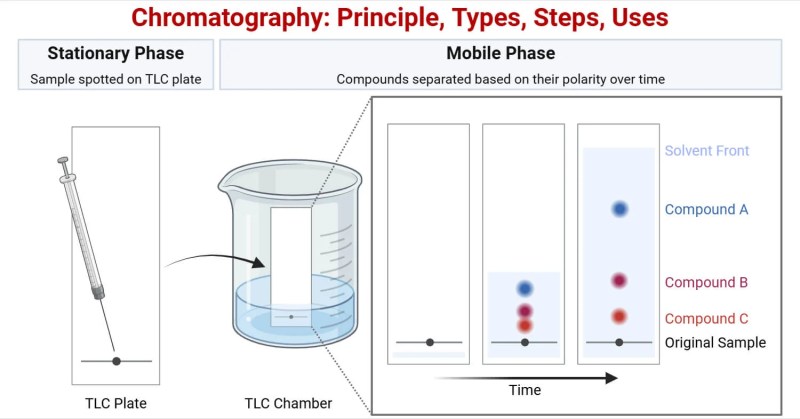
At its essence, chromatography operates on the principle of differential interactions between the components of a mixture and the stationary and mobile phases. The stationary phase, typically a solid or a liquid coated onto a solid support, is immobile and provides the selective surface for component interactions. The mobile phase, either a gas or liquid, carries the sample components through the stationary phase, resulting in their separation based on their relative affinities for the two phases.
Several factors influence the separation efficiency and selectivity in chromatography, including the nature of the stationary and mobile phases, the flow rate of the mobile phase, and the temperature. By carefully manipulating these parameters, analysts can optimize the separation of complex mixtures, allowing for the identification, quantification, and purification of individual components. This fundamental understanding of chromatography's mechanisms underpins its diverse applications across science and industry.
Table of Contents
- Unveiling the Versatility: What is Chromatography Used For?
- The Complete Overview of Chromatography's Applications
- Historical Background and Evolution
- Core Mechanisms: How Chromatography Works
- Key Benefits and Crucial Impact
- Major Advantages
- Comparative Analysis
- Future Trends and Innovations
- Conclusion
- Comprehensive FAQs
- Q: What is the basic principle behind chromatography?
- Q: How does chromatography differ from other separation techniques?
- Q: What are some common types of chromatography used in laboratories?
- Q: How does chromatography contribute to environmental monitoring?
- Q: What role does chromatography play in the pharmaceutical industry?

Key Benefits and Crucial Impact
Chromatography's impact transcends disciplinary boundaries, offering a unique combination of benefits that address critical needs across various sectors. Its ability to provide high-resolution separations with exceptional sensitivity and selectivity is a cornerstone of its utility. This capability enables the detection and quantification of trace components in complex matrices, a crucial requirement in fields such as environmental monitoring, forensics, and pharmaceutical analysis.
Furthermore, chromatography's versatility allows for the analysis of a wide range of sample types, from gases and liquids to solids and biological specimens. This adaptability, coupled with the development of specialized techniques like supercritical fluid chromatography and capillary electrophoresis, extends chromatography's reach into new and emerging areas of research and application.
"Chromatography has become an indispensable tool in modern analytical chemistry, enabling scientists to unravel the complexities of natural and synthetic mixtures with unprecedented precision."
Major Advantages
- High Sensitivity and Selectivity: Chromatography's ability to detect and quantify trace components in complex matrices is crucial for environmental monitoring, drug development, and forensics.
- Versatility in Sample Types: From gases to biological specimens, chromatography can analyze a wide range of samples, making it a universal tool in various industries.
- Robust Data and Results: The technique provides reliable and reproducible data, ensuring the accuracy and consistency required for regulatory compliance and scientific research.
- Adaptability to Emerging Needs: With continuous advancements, chromatography techniques evolve to address new challenges, such as the analysis of novel materials and biological molecules.
- Multidisciplinary Impact: Chromatography's applications span chemistry, biology, environmental science, and more, underscoring its significance in driving scientific progress.
Comparative Analysis
| Parameter | Chromatography | Alternative Techniques |
|---|---|---|
| Separation Efficiency | High, with exceptional resolution and selectivity | Varies; some techniques may offer lower resolution |
| Sample Types | Versatile; can handle gases, liquids, solids, and biological samples | More limited in some cases, depending on the technique |
| Sensitivity | Extremely high, capable of detecting trace components | Varies; some techniques may have lower sensitivity |
| Adaptability | Highly adaptable, with continuous innovations to meet new challenges | Adaptability varies; some techniques may require significant modifications |
Future Trends and Innovations
As science and technology continue to advance, chromatography is poised to evolve further, addressing emerging challenges and expanding its reach. The integration of artificial intelligence (AI) and machine learning (ML) algorithms promises to revolutionize data analysis and interpretation, enhancing the efficiency and accuracy of chromatographic techniques. Moreover, the development of lab-on-a-chip devices and microfluidic systems is paving the way for miniaturized, portable chromatography systems, capable of performing complex analyses in point-of-care and field settings.
In the realm of sustainability, green chromatography techniques are gaining prominence, focusing on the use of environmentally friendly solvents and materials. These innovations not only reduce the environmental impact of analytical processes but also align with the growing global emphasis on sustainable practices. Additionally, the integration of chromatography with other analytical techniques, such as mass spectrometry and nuclear magnetic resonance (NMR) spectroscopy, is opening new avenues for comprehensive, multi-dimensional analysis, further enhancing the technique's versatility and power.
Conclusion
The question "what is chromatography used for?" reveals a vast and ever-expanding landscape of applications, underscoring the technique's indispensable role in modern science and industry. From its humble beginnings in plant pigment analysis to its current status as a cornerstone of analytical chemistry, chromatography has continuously evolved to meet the changing needs of researchers and practitioners across disciplines. Its ability to separate, identify, and quantify complex mixtures with unparalleled precision and versatility makes it an irreplaceable tool in fields as diverse as environmental science, pharmaceuticals, and biotechnology.
As we look to the future, the trajectory of chromatography's development is marked by innovation and sustainability, with emerging technologies and green practices poised to further enhance its impact. Whether in the context of environmental monitoring, drug discovery, or fundamental research, chromatography will undoubtedly continue to play a pivotal role, driving scientific progress and addressing global challenges with unparalleled efficacy.
Comprehensive FAQs
Q: What is the basic principle behind chromatography?
A: Chromatography operates on the principle of differential interactions between the components of a mixture and the stationary and mobile phases. Components interact differently with these phases, leading to their separation based on their relative affinities.
Q: How does chromatography differ from other separation techniques?
A: Chromatography offers higher resolution, sensitivity, and selectivity compared to many other separation techniques. Its versatility in handling various sample types and adaptability to different analytical needs set it apart.
Q: What are some common types of chromatography used in laboratories?
A: Common types include gas chromatography (GC), high-performance liquid chromatography (HPLC), thin-layer chromatography (TLC), and supercritical fluid chromatography (SFC), each suited for specific applications and sample types.
Q: How does chromatography contribute to environmental monitoring?
A: Chromatography is crucial for detecting and quantifying pollutants in air, water, and soil. It helps in identifying the presence and concentration of contaminants, aiding in environmental protection and regulatory compliance.
Q: What role does chromatography play in the pharmaceutical industry?
A: Chromatography is essential for drug development, quality control, and regulatory compliance. It helps in identifying active pharmaceutical ingredients, ensuring product purity, and meeting stringent regulatory standards.
Leave a Comment
Comments are moderated before appearing. The data you submit is processed according to the Privacy Policy of stanford.edu.