Unraveling the Concept: What is a Control Variable?
In the realm of scientific inquiry and data analysis, precision is paramount. Researchers and analysts alike employ various methodologies to ensure the accuracy and reliability of their findings. Central to these methods is the concept of what is a control variable, a tool that allows for the isolation and manipulation of specific factors to better understand their impact on outcomes.
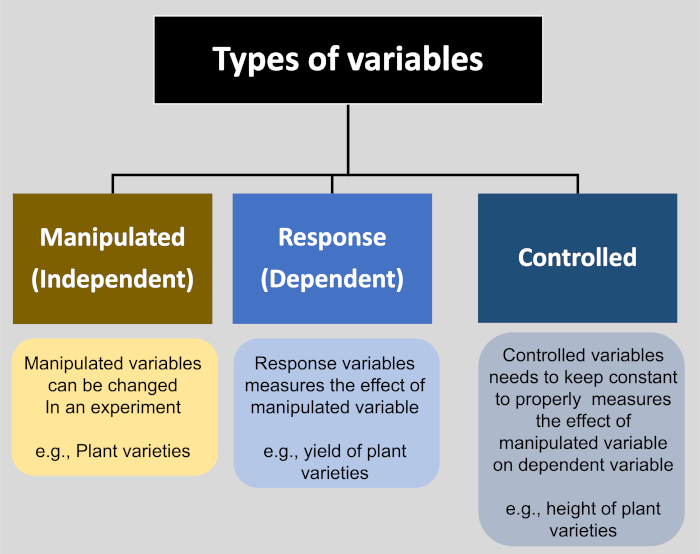
Control variables, often referred to as controlling factors or constant variables, are elements within an experimental design that researchers hold constant to prevent them from influencing the results. By doing so, they can attribute any observed changes or effects to the independent variable under investigation, thereby drawing more reliable conclusions.
This practice is not merely a technical aspect of research but a philosophical one as well, reflecting the scientific community's commitment to rigor and the pursuit of truth. Whether in the physical sciences, social sciences, or any other field, understanding what is a control variable and how to employ it effectively is fundamental to advancing knowledge.

The Complete Overview of Control Variables
Control variables are an integral part of experimental design, serving to isolate the effects of the independent variable on the dependent variable. By holding control variables constant, researchers can ensure that any observed changes in the dependent variable are indeed caused by the manipulation of the independent variable, rather than by other external factors.
This approach is predicated on the understanding that in any given system, multiple variables can interact in complex ways. By controlling all but the independent and dependent variables, researchers create a more predictable and manageable environment for their experiments. This not only enhances the internal validity of the study but also facilitates the extrapolation of findings to real-world contexts.
Historical Background and Evolution
The concept of control variables has its roots in the early days of scientific methodology, when researchers began to formalize the process of experimentation. The need for controls became evident as scientists sought to distinguish between cause-and-effect relationships and mere correlations. Over time, the use of control variables evolved from a practical necessity to a cornerstone of scientific rigor.
Table of Contents
- The Complete Overview of Control Variables
- Historical Background and Evolution
- Core Mechanisms: How Control Variables Work
- Key Benefits and Crucial Impact
- Major Advantages
- Comparative Analysis
- Future Trends and Innovations
- Conclusion
- Comprehensive FAQs
- Q: What exactly is a control variable in experimental design?
- Q: Why are control variables important in scientific research?
- Q: How do control variables impact the generalizability of research results?
- Q: Can you provide an example of a control variable in a real-world study?
- Q: How do control variables differ from independent and dependent variables?
In the 17th century, the scientific revolution brought forth figures like Galileo Galilei and Francis Bacon, who advocated for empirical methods in science. Their work laid the groundwork for the controlled experimental designs we use today. By the 19th and 20th centuries, the concept of control variables was firmly established in scientific discourse, with disciplines like physics, chemistry, and biology adopting it as standard practice. More recently, the expansion of social sciences and data-driven research has further emphasized the importance of control variables in ensuring the reliability and validity of findings.
Core Mechanisms: How Control Variables Work
At its core, the mechanism of a control variable involves identifying and managing factors that could potentially influence the outcome of an experiment. This process begins with the formulation of a research hypothesis, which guides the selection of the independent and dependent variables. Control variables are then identified as those factors that, if left unchecked, could confound the results.
Once identified, control variables are systematically manipulated or held constant throughout the experiment. This might involve keeping environmental conditions consistent, using standardized protocols, or employing statistical techniques to account for potential variations. By doing so, researchers can isolate the effect of the independent variable on the dependent variable, thereby establishing a clearer understanding of the causal relationships at play.
Key Benefits and Crucial Impact
The implementation of control variables in research design offers several significant advantages, each contributing to the overall robustness of scientific findings.
"Control variables are the unsung heroes of scientific discovery, quietly ensuring that our conclusions are built on solid ground rather than shifting sands." - Dr. Emily Walker, Research Methodologist
Major Advantages
- Enhanced Internal Validity: By isolating the effect of the independent variable, control variables minimize the influence of extraneous variables, thereby strengthening the causal inferences that can be drawn from the study.
- Improved Reliability: Consistent control of variables across experiments allows for replication of results, a cornerstone of scientific reliability.
- Better Generalizability: Well-controlled experiments provide a clearer understanding of the conditions under which the observed effects occur, facilitating the extrapolation of findings to broader contexts.
- Facilitated Data Analysis: With control variables in place, statistical analyses become more straightforward, as the data are less prone to confounding effects.
- Ethical Considerations: In certain fields, such as medical research, control variables help ensure the safety and ethicality of experiments by managing potentially harmful or sensitive factors.

Comparative Analysis
| Aspect | Control Variables | Without Control Variables |
|---|---|---|
| Causal Inference | Enables clearer distinction between cause and effect | High risk of attributing effects to wrong variables |
| Replication | Facilitates replication of results | Results may not be reproducible |
| External Validity | Enhances generalizability of findings | Findings may be specific to the unique context |
| Statistical Analysis | Simplifies data analysis | Complicates interpretation due to confounding variables |
Future Trends and Innovations
As the field of research continues to evolve, so too will the application and understanding of control variables. Emerging trends in data science, machine learning, and artificial intelligence are already reshaping how we approach experimental design. Advanced statistical methods and modeling techniques are allowing researchers to control for a greater number of variables simultaneously, enhancing the precision and scope of their studies.
Moreover, the growing emphasis on interdisciplinary research is leading to new methodologies that integrate control variable techniques across diverse fields. This synthesis of approaches promises to yield more holistic and nuanced understandings of complex systems, from ecological dynamics to human behavior. As technology advances and our understanding of the world deepens, the role of control variables will only become more pivotal in guiding scientific discovery.
Conclusion
The concept of what is a control variable is a linchpin of scientific inquiry, enabling researchers to navigate the complexities of causal relationships with precision and rigor. By holding constant those factors that could otherwise confound results, control variables ensure the reliability and validity of experimental findings. As we look to the future, the continued evolution of control variable techniques will undoubtedly open new frontiers in scientific discovery, fostering a deeper understanding of the world around us.
Whether in the laboratory or the field, the principled application of control variables remains a cornerstone of scientific methodology. As we strive for ever-greater insights, the humble control variable will stand as a testament to the power of meticulous observation and controlled experimentation in the pursuit of knowledge.
Comprehensive FAQs
Q: What exactly is a control variable in experimental design?
A: A control variable is any factor that a researcher holds constant or manipulates systematically in an experiment to ensure that any observed changes in the dependent variable are due to the independent variable and not other external factors.
Q: Why are control variables important in scientific research?
A: Control variables are crucial because they enhance the internal validity of a study by isolating the effect of the independent variable. This allows researchers to draw more reliable causal inferences and improves the overall robustness of scientific findings.
Q: How do control variables impact the generalizability of research results?
A: By controlling for potential confounds, control variables help ensure that the observed effects are applicable beyond the specific context of the experiment. This enhances the external validity and generalizability of the research findings.
Q: Can you provide an example of a control variable in a real-world study?
A: In a study examining the effect of fertilizer on plant growth, the type and amount of soil used could be a control variable. By keeping these factors constant across all experimental conditions, researchers can attribute any differences in growth solely to the fertilizer treatment.
Q: How do control variables differ from independent and dependent variables?
A: While the independent variable is the factor being manipulated in an experiment and the dependent variable is the outcome being measured, control variables are the additional factors that researchers hold constant to ensure the integrity of the results. They are not the primary focus of the study but are essential for isolating the effect of the independent variable.
Leave a Comment
Comments are moderated before appearing. The data you submit is processed according to the Privacy Policy of stanford.edu.