Uncovering What Are the Common Multiples of 4 and 10: A Comprehensive Exploration

Uncovering What Are the Common Multiples of 4 and 10: A Comprehensive Exploration
In the realm of mathematics, understanding multiples is fundamental to grasping more complex numerical concepts. When we explore what are the common multiples of 4 and 10, we embark on a journey that intertwines number theory with practical applications. This exploration not only satisfies intellectual curiosity but also sheds light on real-world scenarios where these multiples play a crucial role.
The quest to identify common multiples of 4 and 10 involves recognizing the shared products of these two numbers. This process offers insights into their mathematical relationship and the broader implications in fields such as engineering, music, and even everyday scheduling. By delving deeper, we uncover the methods and significance of finding these common ground in the numerical landscape.
To fully comprehend what are the common multiples of 4 and 10, it's essential to explore their historical background, the mechanisms behind their identification, and the tangible benefits that arise from this knowledge. This comprehensive overview aims to provide a thorough understanding of this mathematical concept and its far-reaching applications.
Historical Background and Evolution
The concept of multiples predates recorded history, with early civilizations recognizing the importance of numbers and their relationships. Ancient mathematicians, such as the Babylonians and Egyptians, laid the groundwork for understanding multiples, though their focus was primarily on practical applications rather than theoretical exploration. The Greek mathematician Euclid, however, formalized many aspects of number theory in his seminal work, "Elements," which included extensive discussions on multiples and divisibility.
Over centuries, mathematicians refined and expanded upon these early understandings. The development of arithmetic and algebra provided tools to systematically identify and study multiples. The 17th and 18th centuries saw further advancements with the emergence of number theory as a distinct branch of mathematics, thanks to the works of mathematicians like Pierre de Fermat and Leonhard Euler. Today, the study of multiples continues to evolve, with modern mathematicians exploring their applications in cryptography, computer science, and other emerging fields.
Core Mechanisms: How It Works
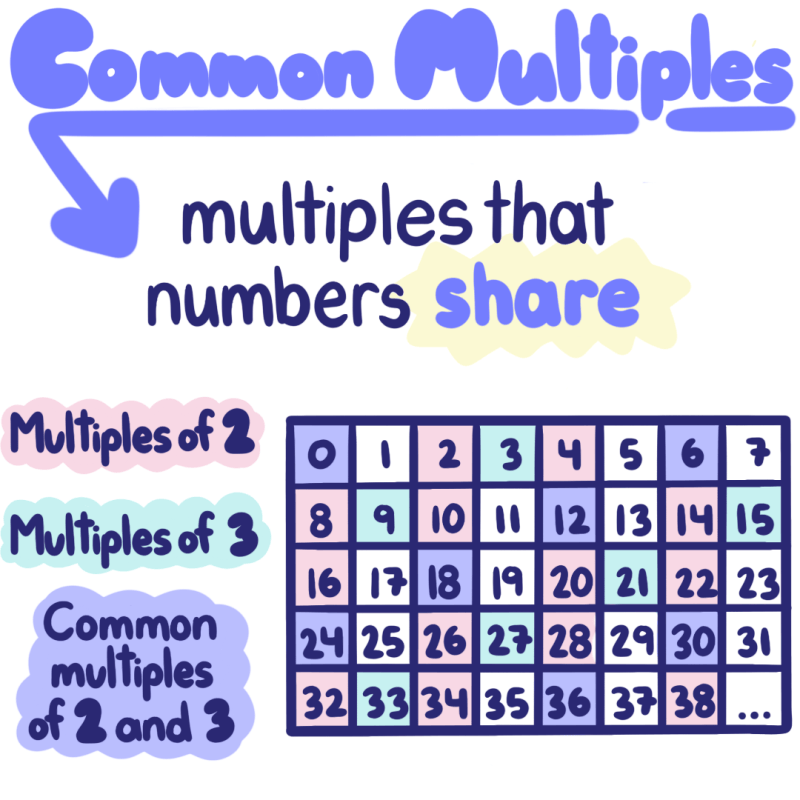
Identifying what are the common multiples of 4 and 10 involves understanding the fundamental properties of multiples and the process of finding their common ground. A multiple of a number is the product of that number and an integer. For instance, 4 multiplied by 3 equals 12, so 12 is a multiple of 4. Similarly, 10 multiplied by 2 also equals 20, making 20 a multiple of 10.
To find the common multiples of 4 and 10, we look for numbers that are multiples of both. These are numbers that can be expressed as the product of 4 and an integer m, as well as 10 and an integer n. The least common multiple (LCM) is a key concept here, representing the smallest positive integer that is divisible by both 4 and 10. The LCM of 4 and 10 is 20, meaning 20 is the first and smallest number that satisfies the condition of being a multiple of both 4 and 10.
Table of Contents
- Uncovering What Are the Common Multiples of 4 and 10: A Comprehensive Exploration
- Historical Background and Evolution
- Core Mechanisms: How It Works
- Key Benefits and Crucial Impact
- Major Advantages
- Comparative Analysis
- Future Trends and Innovations
- Conclusion
- Comprehensive FAQs
- Q: What is a multiple in mathematics?
- Q: How do you find the least common multiple (LCM) of two numbers?
- Q: What are some practical applications of knowing the common multiples of 4 and 10?
- Q: How do common multiples relate to real-world scenarios?
- Q: What role do common multiples play in the development of technology?
Key Benefits and Crucial Impact
Understanding what are the common multiples of 4 and 10 extends beyond theoretical mathematics, offering practical advantages in various domains. This knowledge is instrumental in solving real-world problems, from construction and manufacturing to music composition and computer programming.
"Mathematics is not about numbers, equations, computations, or algorithms: it is about understanding." - William Paul Thurston
Major Advantages
- Efficient Resource Allocation: In industries such as manufacturing and construction, understanding common multiples helps in optimizing resource allocation. For instance, when designing a production line that requires both batches of 4 and 10 items, knowing their common multiples ensures efficient scheduling and inventory management.
- Harmonic Relationships in Music: In music theory, common multiples are essential for understanding harmonic relationships. Musicians use these concepts to create pleasing chords and rhythms, ensuring that different musical elements sync perfectly.
- Algorithm Development: In computer science, knowledge of common multiples is crucial for developing efficient algorithms. This is particularly evident in areas like cryptography, where multiples play a pivotal role in creating secure encryption systems.
- Educational Foundation: For students, grasping the concept of common multiples strengthens their mathematical foundation. It enhances problem-solving skills and fosters a deeper understanding of numbers, setting a solid groundwork for more advanced mathematical concepts.
- Everyday Problem Solving: In daily life, recognizing common multiples can simplify tasks such as dividing tasks evenly among a group or planning events with specific time constraints.
Comparative Analysis
| Aspect | Multiples of 4 | Multiples of 10 |
|---|---|---|
| Definition | Numbers that can be expressed as 4 times an integer | Numbers that can be expressed as 10 times an integer |
| Examples | 4, 8, 12, 16, 20... | 10, 20, 30, 40, 50... |
| Common Multiples | 20, 40, 60, 80... | 20, 40, 60, 80... |
| Applications | Even distribution, binary numbers, digital signals | Decimal system, measurements, currency |
Future Trends and Innovations
As technology continues to advance, the role of mathematics, and specifically the understanding of multiples, becomes increasingly pivotal. In the era of big data and artificial intelligence, efficient algorithms and secure encryption systems rely heavily on the principles of number theory. The exploration of what are the common multiples of 4 and 10 will likely contribute to the development of more sophisticated AI models and data processing techniques.
Moreover, as we venture into new frontiers such as quantum computing, the fundamental understanding of multiples and their relationships will be essential in designing quantum algorithms and solving complex problems that are currently beyond the reach of classical computers. The future of mathematics and technology is inextricably linked, with the study of multiples playing a crucial role in shaping these advancements.

Conclusion
The quest to understand what are the common multiples of 4 and 10 is not merely an exercise in theoretical mathematics but a journey that reveals the profound interconnectedness of numbers. From ancient civilizations to modern-day innovations, the concept of multiples has evolved, yet its significance remains paramount. Whether in the realm of music, technology, or everyday problem-solving, recognizing common multiples offers practical advantages and deepens our understanding of the world around us.
As we continue to explore and apply these mathematical concepts, we not only honor the achievements of past mathematicians but also contribute to the ongoing narrative of human discovery and innovation. The study of multiples, in all its complexity and elegance, remains a cornerstone of mathematical exploration, offering endless possibilities for future breakthroughs.
Comprehensive FAQs
Q: What is a multiple in mathematics?
A: A multiple of a number is the product of that number and an integer. For example, 12 is a multiple of 4 because 12 = 4 3.
Q: How do you find the least common multiple (LCM) of two numbers?
A: The LCM of two numbers is the smallest positive integer that is divisible by both. It can be found through various methods, including prime factorization, listing multiples, or using the LCM formula.
Q: What are some practical applications of knowing the common multiples of 4 and 10?
A: Knowing the common multiples of 4 and 10 can be applied in resource allocation, music composition, algorithm development, education, and everyday problem-solving. It ensures efficient distribution, harmonic relationships in music, and optimized processes in various industries.
Q: How do common multiples relate to real-world scenarios?
A: Common multiples are crucial in real-world scenarios where tasks or resources need to be divided evenly among a group or where specific time constraints are involved. They ensure that operations run smoothly and efficiently.
Q: What role do common multiples play in the development of technology?
A: Common multiples are fundamental in technology, especially in algorithm development, encryption systems, and data processing. They are essential for creating efficient and secure digital solutions, and their importance is expected to grow with the advent of quantum computing.
Leave a Comment
Comments are moderated before appearing. The data you submit is processed according to the Privacy Policy of stanford.edu.