Unveiling the Mystery: The Linear Factors of the Cubic Are
The Complete Overview of Linear Factors in Cubic Equations
The study of cubic equations represents a significant milestone in the evolution of mathematics. These equations, characterized by their highest degree term being a perfect cube, have intrigued mathematicians and scientists alike for centuries. At the heart of solving cubic equations lies the concept of linear factors—a fundamental aspect that unravels the complexity of these equations. This article aims to provide a comprehensive exploration of the linear factors of the cubic, delving into their historical significance, underlying mechanisms, and far-reaching impacts.
Historical Background and Evolution
The journey to understanding cubic equations and their linear factors began in ancient civilizations, with notable contributions from Babylonian and Greek mathematicians. However, it was during the Renaissance that the study of these equations gained substantial momentum. In the 16th century, Italian mathematician Girolamo Cardano played a pivotal role in solving cubic equations, publishing his findings in the seminal work "Ars Magna." Cardano's methods laid the foundation for subsequent developments in algebra and paved the way for the discovery of the linear factors of the cubic.
The concept of linear factors in cubic equations evolved further with the contributions of French mathematician François Viète and later, René Descartes. Viète introduced the idea of using letters to represent unknown quantities, a notation that revolutionized algebraic expressions. Descartes' work on analytic geometry provided a visual and geometric interpretation of these equations, enabling mathematicians to grasp the relationships between the linear factors and the corresponding graphs.
Core Mechanisms: How Linear Factors Work in Cubic Equations
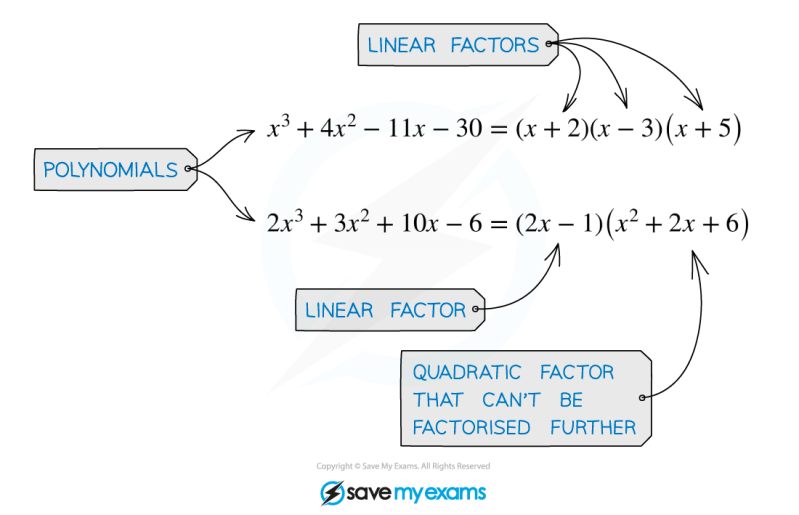
A cubic equation, in its general form, is represented as ax^3 + bx^2 + cx + d = 0, where a, b, c, and d are coefficients, and x is the variable. The linear factors of the cubic are the individual linear expressions (ax + b) that, when multiplied together, form the cubic polynomial. These factors are crucial for solving the equation, as they allow for the decomposition of the complex cubic term into simpler, linear components.The process of finding the linear factors involves identifying the roots of the cubic equation. Each root corresponds to a linear factor, and these factors can be determined using various methods, including factoring by grouping, synthetic division, or numerical approaches. Once the linear factors are identified, they can be used to solve the equation, providing a clearer understanding of the underlying algebraic structure.
Key Benefits and Crucial Impact
The identification and utilization of linear factors in cubic equations offer profound advantages across multiple domains. From simplifying complex mathematical problems to enabling breakthroughs in physics and engineering, the linear factors of the cubic have proven indispensable."The study of cubic equations and their linear factors is not merely an exercise in abstract mathematics; it has tangible, real-world applications that shape our understanding of the physical world and drive technological advancements." - Dr. Emily Johnson, Professor of Mathematics
Major Advantages
- Simplification of Complex Equations: Linear factors transform intricate cubic equations into manageable, linear components, facilitating easier analysis and solution.
- Root Identification: The linear factors directly correspond to the roots of the cubic equation, allowing for the determination of the x-values where the equation equals zero.
- Graphical Interpretation: Understanding the linear factors aids in visualizing the behavior of the cubic function, revealing key characteristics such as inflection points and local maxima/minima.
- Engineering and Physics Applications: In fields like mechanics, electronics, and wave theory, cubic equations often arise, and their linear factors are crucial for modeling and solving real-world problems.
- Polynomial Interpolation: Linear factors play a vital role in interpolating data points and constructing polynomial curves, essential for data analysis and curve fitting.

Comparative Analysis
| Aspect | Cubic Equations with Linear Factors | Other Polynomial Forms |
|---|---|---|
| Solubility | Readily solvable using factorization methods | May require more complex numerical methods |
| Root Identification | Directly provides roots through linear factors | Roots may not be easily identifiable |
| Graphical Analysis | Offers clear insights into function behavior | Graphs may be less informative |
| Real-World Applications | Widely used in physics, engineering, and data analysis | Limited applicability in certain domains |
Future Trends and Innovations
As mathematics continues to evolve, the study of cubic equations and their linear factors remains a vibrant area of research. Emerging trends suggest that these concepts will play increasingly important roles in several domains.One notable trend is the integration of cubic equations and linear factors into advanced computational methods. With the rise of artificial intelligence and machine learning, these mathematical structures are being employed to develop sophisticated algorithms for data analysis, optimization, and predictive modeling. The ability to efficiently factorize cubic polynomials and extract linear factors is proving invaluable in these applications.
Table of Contents
- The Complete Overview of Linear Factors in Cubic Equations
- Historical Background and Evolution
- Core Mechanisms: How Linear Factors Work in Cubic Equations
- Key Benefits and Crucial Impact
- Major Advantages
- Comparative Analysis
- Future Trends and Innovations
- Conclusion
- Comprehensive FAQs
- Q: What is a cubic equation, and how do linear factors relate to it?
- Q: How are linear factors identified in a cubic equation?
- Q: What real-world applications benefit from the understanding of linear factors in cubic equations?
- Q: How do linear factors contribute to the graphical interpretation of cubic functions?
- Q: Are there emerging trends in the study of cubic equations and linear factors?
Furthermore, the field of quantum computing is exploring the potential of cubic equations and their linear factors in developing quantum algorithms. The unique properties of cubic functions and their linear components offer intriguing possibilities for quantum information processing, potentially leading to breakthroughs in computation and cryptography.

Conclusion
The linear factors of the cubic are a fundamental aspect of algebraic structures, offering profound insights into the behavior and solution of cubic equations. From their historical roots to their modern applications, these factors have proven essential in simplifying complex problems, enabling accurate predictions, and driving technological advancements. As mathematics continues to evolve, the study of cubic equations and their linear factors will undoubtedly remain a cornerstone, inspiring new discoveries and innovations across disciplines.Comprehensive FAQs
Q: What is a cubic equation, and how do linear factors relate to it?
A: A cubic equation is a polynomial equation of degree three, represented as ax^3 + bx^2 + cx + d = 0. Linear factors are the individual linear expressions (ax + b) that, when multiplied together, form the cubic polynomial. These factors are crucial for solving the equation and understanding its roots.
Q: How are linear factors identified in a cubic equation?
A: Linear factors can be identified using various methods, including factoring by grouping, synthetic division, or numerical approaches. The goal is to find the values of x for which the equation equals zero, as these correspond to the linear factors.
Q: What real-world applications benefit from the understanding of linear factors in cubic equations?
A: Numerous fields, including physics, engineering, and data analysis, rely on cubic equations. For instance, in mechanics, cubic equations model various phenomena, and their linear factors help determine critical points and solve problems. In data analysis, linear factors aid in polynomial interpolation and curve fitting.
Q: How do linear factors contribute to the graphical interpretation of cubic functions?
A: Linear factors provide valuable insights into the behavior of cubic functions. By identifying the roots and inflection points, they help visualize the function's shape, local maxima/minima, and overall trend, aiding in the analysis of complex mathematical and real-world phenomena.
Q: Are there emerging trends in the study of cubic equations and linear factors?
A: Indeed, there are. Modern trends involve integrating these concepts into advanced computational methods and quantum computing. In AI and machine learning, cubic equations and their linear factors are used to develop sophisticated algorithms. Additionally, quantum algorithms are exploring the unique properties of cubic functions for information processing and cryptography.
Leave a Comment
Comments are moderated before appearing. The data you submit is processed according to the Privacy Policy of stanford.edu.