Solving Systems of Linear Equations by Matrices: A Comprehensive Exploration

The Complete Overview of Solving Systems of Linear Equations by Matrices
Solving systems of linear equations is a fundamental problem in mathematics with wide-ranging applications across science, engineering, and economics. Among various methods, the use of matrices offers a powerful, systematic approach. This technique allows for efficient manipulation and solution of complex systems, making it an indispensable tool in modern mathematics and its applications. This article delves into the intricacies of solving systems of linear equations by matrices, tracing its historical evolution, exploring core mechanisms, and highlighting key benefits.
Matrices, rectangular arrays of numbers, encapsulate the coefficients and constants of linear equations, providing a concise representation that lends itself to algebraic manipulation. The method of using matrices to solve such systems not only simplifies the process but also facilitates the exploration of more complex mathematical problems and their real-world applications. Whether in optimizing resource allocation, modeling physical systems, or deciphering cryptographic codes, the matrix approach to solving linear equations stands as a cornerstone in the arsenal of mathematical techniques.
Historical Background and Evolution
The concept of matrices and their application in solving linear systems traces its roots back to the 18th and 19th centuries. Early work by mathematicians such as Gauss and Cauchy laid the foundation for matrix algebra, with Gauss notably employing matrix methods to solve systems of equations in his work on celestial mechanics. The term "matrix" itself was coined by James Joseph Sylvester in the mid-19th century, derived from the Latin word for "womb," reflecting the idea of a matrix containing elements from which something is generated.Over the ensuing decades, matrix theory and its application in solving linear equations evolved significantly. The development of determinant theory, crucial for understanding the invertibility of matrices and their use in solving systems, was a major milestone. The 20th century saw the integration of matrices into abstract algebra and the advent of computational methods, further expanding the utility of matrix-based approaches in solving systems of linear equations. Today, with the advent of high-performance computing, matrices are not only theoretically important but also practically indispensable in solving large-scale systems that were once intractable.
Core Mechanisms: How It Works
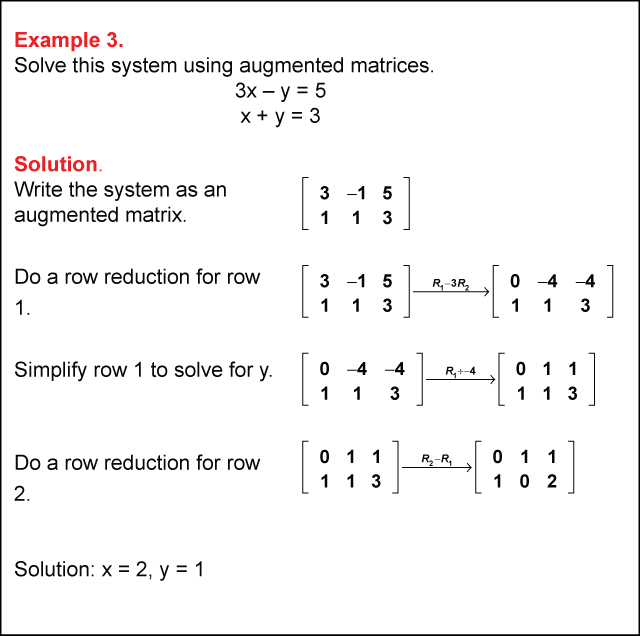
At the heart of solving systems of linear equations by matrices lies the process of setting up and manipulating augmented matrices. An augmented matrix combines the coefficient matrix (the matrix of variables' coefficients) with the constant matrix (the matrix of constants) in a single structure. This representation allows for a direct application of row operations, such as swapping rows, multiplying rows by scalars, and adding or subtracting rows, to transform the matrix into a triangular form, known as row-echelon form.Once in row-echelon form, back-substitution can be used to solve for the variables one by one. This process is particularly efficient when assisted by computational tools, which can handle large matrices and complex systems with speed and accuracy. Moreover, the Gaussian elimination process, which underlies the transformation to row-echelon form, provides insights into the structure of the solution and the nature of the system (e.g., whether it has a unique solution, infinitely many solutions, or no solution at all).
Key Benefits and Crucial Impact
The use of matrices in solving systems of linear equations offers a multitude of benefits that have significantly impacted various fields."Matrices provide a powerful language for expressing and manipulating linear relationships, making complex problems more manageable and insightful."
Major Advantages
- Compact Representation: Matrices condense complex systems of equations into a single structure, simplifying notation and facilitating analysis.
- Efficient Solution: Matrix methods, particularly when aided by computational tools, offer efficient and accurate solutions to large systems of equations.
- Structural Insights: The process of Gaussian elimination and the resulting row-echelon form provide insights into the nature of the system's solutions.
- Versatility: Matrix-based methods apply to a wide range of systems, from simple to highly complex, making them universally useful.
- Foundation for Advanced Mathematics: Proficiency in matrix methods is essential for more advanced topics in linear algebra, differential equations, and beyond.
Comparative Analysis
| Method | Solving Systems of Linear Equations by Matrices |
|---|---|
| Ease of Representation | High - Compact and clear representation of complex systems |
| Scalability | Excellent - Efficiently handles large systems with computational assistance |
| Insight into Solution Structure | Good - Provides information on the nature of solutions through row-echelon form |
| Computational Requirements | Moderate - Requires computational tools for efficient handling of large matrices |
Future Trends and Innovations
As computational power continues to grow, the role of matrices in solving systems of linear equations is poised to expand further. Advances in numerical methods and algorithms, such as parallel computing and specialized solvers, will enable the handling of even larger and more complex systems. Moreover, the integration of machine learning and artificial intelligence techniques with matrix methods holds promise for adaptive, intelligent solving of linear systems, optimizing performance and efficiency in real-world applications.Theoretical developments in matrix theory and linear algebra will also continue to refine our understanding of these systems, leading to new insights and applications. The future looks bright for matrix-based approaches, with their central role in education, research, and industry expected to grow, underpinned by technological advancements and the increasing complexity of problems requiring mathematical solutions.
Table of Contents
- The Complete Overview of Solving Systems of Linear Equations by Matrices
- Historical Background and Evolution
- Core Mechanisms: How It Works
- Key Benefits and Crucial Impact
- Major Advantages
- Comparative Analysis
- Future Trends and Innovations
- Conclusion
- Comprehensive FAQs
- Q: What are the basic steps in solving a system of linear equations using matrices?
- Q: How do matrices provide insights into the nature of solutions to linear systems?
- Q: What are the advantages of using matrices over other methods for solving linear systems?
- Q: How do computational tools enhance the use of matrices in solving linear equations?
- Q: What future developments are expected in the field of solving linear systems using matrices?

Conclusion
Solving systems of linear equations by matrices represents a powerful and versatile method with wide-ranging applications. From its historical roots to its modern computational implementations, the matrix approach has proven indispensable in tackling complex mathematical problems and their real-world manifestations. As we look ahead, the continued evolution of computational tools and mathematical theory promises to extend the reach and impact of matrix methods, making them an essential part of the mathematical landscape for years to come.Comprehensive FAQs
Q: What are the basic steps in solving a system of linear equations using matrices?
A: The process typically involves setting up an augmented matrix, performing row operations to achieve row-echelon form, and then using back-substitution to solve for the variables.
Q: How do matrices provide insights into the nature of solutions to linear systems?
A: The row-echelon form of the matrix reveals whether the system has a unique solution, infinitely many solutions, or no solution, based on the existence and uniqueness of the solution to the corresponding homogeneous system.
Q: What are the advantages of using matrices over other methods for solving linear systems?
A: Matrices offer compact representation, efficiency (especially with computational aid), versatility, and deep insights into the structure of solutions, making them particularly well-suited for complex systems.
Q: How do computational tools enhance the use of matrices in solving linear equations?
A: Computational tools enable efficient handling of large matrices, accelerate the solution process, and improve accuracy, making matrix methods practical for real-world applications involving complex systems.
Q: What future developments are expected in the field of solving linear systems using matrices?
A: Advancements in computational methods, including parallel computing and AI-driven algorithms, will further enhance the efficiency and scalability of matrix-based approaches, extending their applicability to even more complex problems.
Leave a Comment
Comments are moderated before appearing. The data you submit is processed according to the Privacy Policy of stanford.edu.