Solving Exponential Equations with Logarithms Worksheet: A Comprehensive Exploration
Exponential equations, with their inherent complexity, have long been a cornerstone of advanced mathematics. Solving these equations often requires the application of logarithms, a concept that unlocks the door to understanding exponential growth and decay. This article, "Solving Exponential Equations with Logarithms Worksheet," aims to provide a comprehensive exploration of this vital mathematical technique, offering insights into its historical roots, core mechanisms, and future applications.
Whether you're a student seeking to master this concept or a professional revisiting fundamental mathematical principles, understanding how to solve exponential equations with logarithms is invaluable. This guide will equip you with the knowledge and practical skills to tackle such equations, ensuring you can apply these principles in various academic and real-world scenarios.
As we navigate through this in-depth analysis, we'll uncover the historical evolution of logarithms and their role in solving exponential equations, delve into the step-by-step processes involved, and explore the significant benefits and impacts of this method. Furthermore, we'll compare it with other mathematical techniques and look ahead to future trends and innovations in this field.

The Complete Overview of Solving Exponential Equations with Logarithms
Solving exponential equations with logarithms is a mathematical technique used to find the unknown values in equations involving exponential functions. Logarithms, as inverse operations of exponentials, allow us to transform complex exponential equations into more manageable linear equations. This method is particularly useful when dealing with problems in physics, engineering, finance, and various other scientific disciplines.
At the heart of this technique lies the fundamental property of logarithms: logb(xn) = n logb(x). This property enables us to rewrite exponential equations in logarithmic form, simplifying the process of solving for the unknown variable. By applying logarithms to both sides of an exponential equation, we can isolate the variable and determine its value.
Historical Background and Evolution
The concept of logarithms dates back to the 17th century, with contributions from notable mathematicians such as John Napier and Henry Briggs. Napier, seeking to simplify calculations for financial and scientific applications, introduced the idea of logarithms as a means to reduce complex multiplications to simple additions. Briggs later refined Napier's work, base-10 logarithms, which became widely adopted in scientific and navigational tools.
Table of Contents
- The Complete Overview of Solving Exponential Equations with Logarithms
- Historical Background and Evolution
- Core Mechanisms: How It Works
- Key Benefits and Crucial Impact
- Major Advantages
- Comparative Analysis
- Future Trends and Innovations
- Conclusion
- Comprehensive FAQs
- Q: What are logarithms, and how do they relate to exponential equations?
- Q: Can you explain the step-by-step process of solving an exponential equation using logarithms?
- Q: What are some real-world applications of solving exponential equations with logarithms?
- Q: How do logarithms compare to other methods for solving exponential equations?
- Q: What future trends can we expect in the field of logarithmic equation-solving?
Over time, logarithms evolved from mere computational aids to essential mathematical tools. The development of slide rules, which utilized logarithmic scales, further popularized their use. In the 19th and 20th centuries, logarithms played a crucial role in various scientific endeavors, including astronomy, physics, and engineering, where exponential relationships are prevalent. Today, while digital calculators have replaced slide rules, logarithms remain fundamental in solving exponential equations and analyzing exponential growth and decay processes.
Core Mechanisms: How It Works
The process of solving exponential equations with logarithms involves several key steps. First, we identify the exponential equation and determine the base of the exponentiation. Next, we apply the logarithm with the same base to both sides of the equation, which, according to the properties of logarithms, allows us to bring down the exponent as a coefficient.
For example, consider the equation 2x = 8. Applying the logarithm with base 2 to both sides, we get log2(2x) = log2(8). Using the logarithmic property mentioned earlier, we can rewrite this as x log2(2) = log2(8). Since log2(2) = 1, the equation simplifies to x = log2(8), which equals 3. This step-by-step approach ensures that we isolate the unknown variable, providing a clear solution to the exponential equation.
Key Benefits and Crucial Impact
Solving exponential equations with logarithms offers several significant advantages, making it an indispensable tool in various mathematical and scientific contexts.
"Logarithms afford us a powerful lens through which we can comprehend and manipulate exponential relationships, enabling solutions to complex problems in fields as diverse as physics, biology, and economics."
Major Advantages
- Simplification of Complex Equations: Logarithms transform exponential equations into linear forms, making them easier to solve and interpret.
- Versatility: This method applies to a wide range of exponential equations, including those with unknown bases, exponents, or variables.
- Real-World Applications: Logarithms are essential in modeling and analyzing real-world phenomena, such as population growth, radioactive decay, and financial compound interest.
- Enhanced Problem-Solving Skills: Mastering this technique improves overall problem-solving abilities, fostering critical thinking and mathematical literacy.
- Foundation for Advanced Mathematics: Understanding logarithms and their role in solving exponential equations is crucial for higher-level mathematics, including calculus and linear algebra.
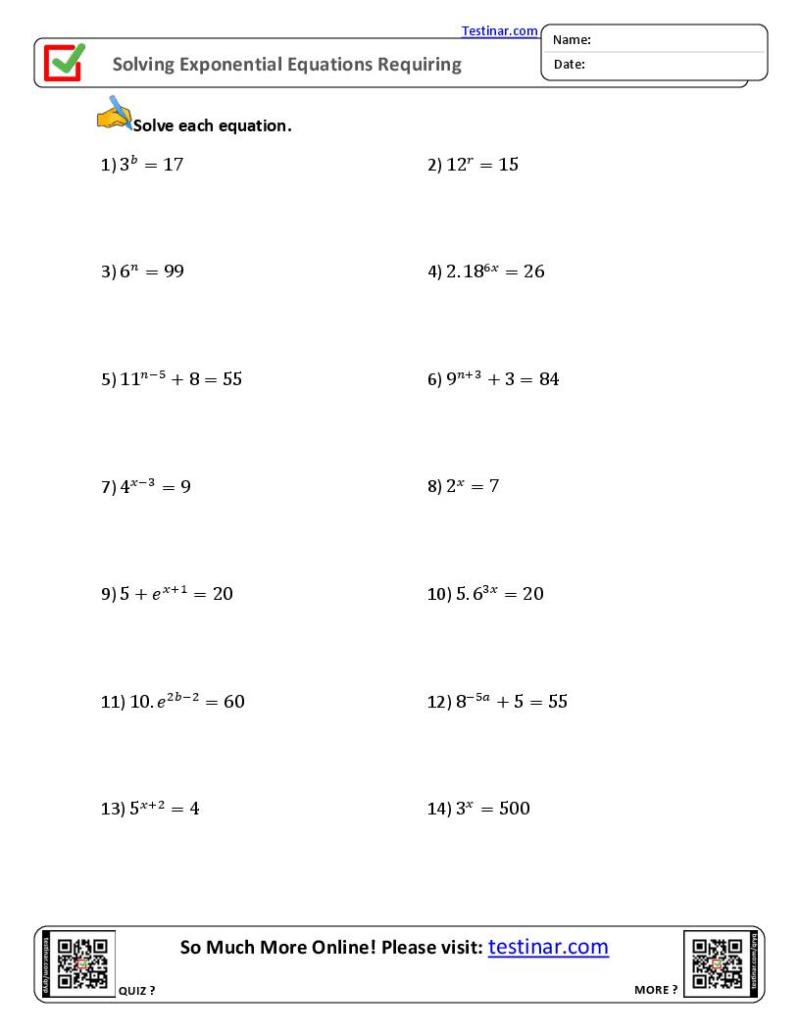
Comparative Analysis
| Method | Solving Exponential Equations with Logarithms |
|---|---|
| Complexity | Moderate; requires understanding of logarithm properties and their application. |
| Versatility | High; applicable to a wide range of exponential equations. |
| Real-World Relevance | Exceptionally high, with applications in numerous scientific and financial fields. |
| Foundation for Advanced Math | Crucial; serves as a foundation for more advanced mathematical concepts. |
Future Trends and Innovations
As mathematics and technology continue to evolve, the role of logarithms and their application in solving exponential equations is likely to expand. With the advent of advanced computational tools and data analysis techniques, logarithmic methods are becoming increasingly relevant in fields such as machine learning, data science, and artificial intelligence.
Moreover, the development of new pedagogical approaches and digital learning platforms is making the learning and teaching of logarithms more accessible and engaging. These innovations promise to enhance understanding and proficiency in solving exponential equations, fostering a new generation of mathematicians and scientists equipped to tackle complex problems.

Conclusion
Solving exponential equations with logarithms is a powerful mathematical technique with a rich history and a wide range of applications. From its origins in computational simplification to its modern-day role in advanced scientific research, logarithms have proven indispensable. As we look to the future, the continued development of this field promises to unlock new possibilities in mathematics, science, and technology.
Whether you are a student, educator, or professional, mastering this technique can significantly enhance your problem-solving abilities and open doors to exciting career opportunities. By understanding the historical context, core mechanisms, and future trends in solving exponential equations with logarithms, you can gain a deeper appreciation for this fundamental mathematical concept.
Comprehensive FAQs
Q: What are logarithms, and how do they relate to exponential equations?
A: Logarithms are the inverse operations of exponentials. They allow us to rewrite exponential equations in a linear form, making them easier to solve. Logarithms and exponential functions are mirror images of each other, sharing the same base and satisfying the property logb(xn) = n logb(x).
Q: Can you explain the step-by-step process of solving an exponential equation using logarithms?
A: Certainly! The process typically involves the following steps: (1) Identify the exponential equation and determine the base. (2) Apply the logarithm with the same base to both sides of the equation. (3) Use the logarithmic property to bring down the exponent as a coefficient. (4) Simplify the equation and solve for the unknown variable.
Q: What are some real-world applications of solving exponential equations with logarithms?
A: This technique has numerous real-world applications, including modeling population growth, analyzing radioactive decay, calculating compound interest in finance, and studying half-life in chemistry and physics. Logarithms are also essential in data analysis, computer science, and various engineering disciplines.
Q: How do logarithms compare to other methods for solving exponential equations?
A: Logarithms offer several advantages, including simplicity and versatility. They transform complex exponential equations into linear forms, making them easier to solve. While other methods exist, such as graphing or numerical approximation, logarithms provide an elegant and precise solution for many types of exponential equations.
Q: What future trends can we expect in the field of logarithmic equation-solving?
A: The future looks bright for logarithmic methods, with advancements in technology and data science driving new applications. Machine learning algorithms, data analysis techniques, and digital learning platforms are likely to incorporate logarithmic concepts, making them more accessible and powerful. These developments will further enhance the relevance of logarithms in solving complex problems across various disciplines.
Leave a Comment
Comments are moderated before appearing. The data you submit is processed according to the Privacy Policy of stanford.edu.