Naming Triangles Congruent by ASA: A Geometric Deep Dive
In the realm of geometry, few concepts are as fundamental yet as profound as congruence. The question, "name two triangles that are congruent by asa," introduces us to a specific criterion for determining when two triangles are identical in shape and size. This criterion, known as the Angle-Side-Angle (ASA) postulate, is a cornerstone in geometric proofs and applications.
Understanding ASA congruence deepens our appreciation for geometric principles, enhances problem-solving skills, and fosters a deeper understanding of the world around us. This article delves into the historical background, core mechanisms, key benefits, and future trends of the ASA postulate, providing a comprehensive overview for both students and enthusiasts.
Moreover, in an era where technology and education intertwine, mastering geometric concepts like ASA congruence opens doors to innovative fields such as computer graphics, architecture, and engineering. By grasping how to "name two triangles that are congruent by asa," individuals equip themselves with a powerful tool for tackling real-world challenges.
The Complete Overview of ASA Congruence
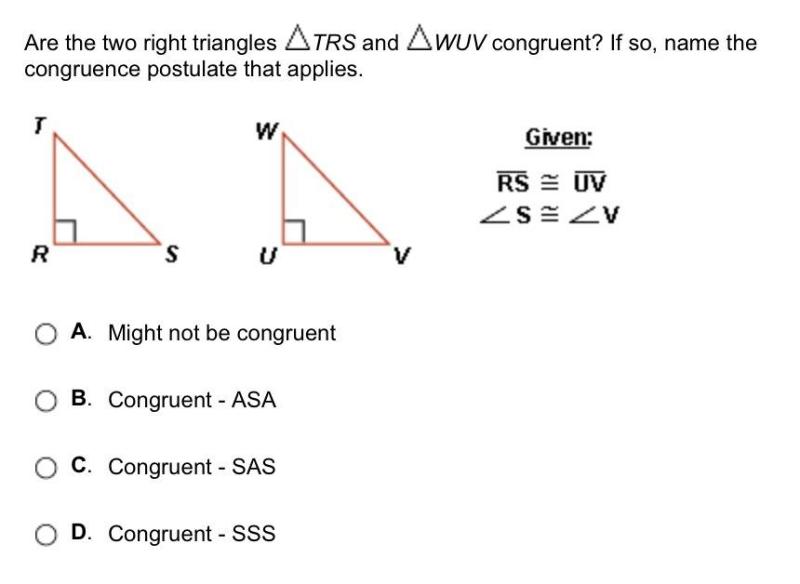
The Angle-Side-Angle (ASA) postulate is a geometric criterion used to prove triangle congruence. It states that if two angles and the included side of one triangle are equal to the corresponding parts of another triangle, the triangles are congruent. In essence, if two angles and the side between them in one triangle match the corresponding parts in another, you can confidently declare the triangles congruent.
This postulate is one among several criteria for triangle congruence, including Side-Angle-Side (SAS), Side-Side-Side (SSS), and Angle-Angle-Side (AAS). Each postulate offers a unique combination of side and angle equality to establish congruence, catering to various geometric scenarios.
Historical Background and Evolution
The roots of geometric congruence postulates trace back to ancient Greek mathematics, with significant contributions from renowned mathematicians like Euclid. In his seminal work, "Elements," Euclid laid the foundations of Euclidean geometry, introducing various theorems and postulates that remain essential today.
Table of Contents
- The Complete Overview of ASA Congruence
- Historical Background and Evolution
- Core Mechanisms: How ASA Congruence Works
- Key Benefits and Crucial Impact
- Major Advantages
- Comparative Analysis
- Future Trends and Innovations
- Conclusion
- Comprehensive FAQs
- Q: What does the ASA postulate state?
- Q: How is ASA congruence different from other congruence criteria?
- Q: What are some real-world applications of the ASA postulate?
- Q: Why is mastering congruence postulates important for students?
- Q: How might geometric literacy, like understanding ASA congruence, evolve in future education?
The ASA postulate, specifically, evolved from Euclid's work on triangle properties and angle relationships. Over centuries, mathematicians refined and formalized these concepts, leading to the structured congruence criteria we use today. The development of ASA congruence was not merely a theoretical exercise but a practical tool for solving real-world problems in fields like architecture, astronomy, and land surveying.
Core Mechanisms: How ASA Congruence Works
At its core, the ASA postulate hinges on the principle that the measure of an angle and the length of a side are invariant properties. When these invariants match between two triangles, the triangles themselves must be congruent. This is because the angles determine the shape, and the sides determine the size; thus, matching angles and sides ensure an exact overlap.
To apply the ASA postulate, one must identify corresponding parts of the triangles. This involves careful measurement and comparison of angles and sides, ensuring that the given conditions are met. Once verified, the postulate guarantees congruence without needing further proof.
Key Benefits and Crucial Impact
The ASA postulate's significance extends far beyond theoretical geometry. Its practical implications touch numerous fields, underscoring its importance in modern education and beyond.
“Geometric concepts, including congruence postulates, form the bedrock of engineering and technological advancements, influencing everything from structural design to computer graphics.”
Major Advantages
- Enhanced Problem-Solving: ASA congruence equips students with a powerful tool for tackling complex geometric problems, fostering critical thinking and logical reasoning.
- Real-World Applications: From construction and architecture to engineering and computer-aided design, understanding ASA congruence is crucial for ensuring accuracy and precision.
- Foundation for Advanced Math: Mastery of congruence postulates serves as a stepping stone to more advanced mathematical concepts, including trigonometry, calculus, and linear algebra.
- Technological Proficiency: In an increasingly digital world, geometric literacy is essential for navigating technologies like CAD software, 3D modeling, and virtual reality.
- Historical and Cultural Understanding: Exploring the historical development of geometric principles provides insights into the evolution of human thought and scientific discovery.

Comparative Analysis
| Congruence Criterion | Requirements |
|---|---|
| ASA (Angle-Side-Angle) | Two angles and the included side |
| SAS (Side-Angle-Side) | Two sides and the included angle |
| SSS (Side-Side-Side) | All three sides |
| AAS (Angle-Angle-Side) | Two angles and a non-included side |
Future Trends and Innovations
As technology continues to advance, the role of geometric literacy, including congruence postulates like ASA, becomes increasingly vital. Emerging fields such as artificial intelligence, robotics, and biotechnology rely heavily on precise geometric understanding for modeling, simulation, and design.
Moreover, the integration of geometric concepts into K-12 curricula is evolving, with a growing emphasis on hands-on learning, digital tools, and real-world applications. This shift prepares students not only for academic success but also for careers in STEM fields, where geometric literacy is a cornerstone.

Conclusion
The question "name two triangles that are congruent by asa" encapsulates a profound yet practical aspect of geometry. Understanding and applying the ASA postulate opens doors to a deeper appreciation of mathematical principles and their real-world applications. As we navigate an increasingly technological future, mastering geometric concepts like congruence will remain a crucial skill, bridging the gap between theory and practice.
Whether in the classroom, the laboratory, or the construction site, the ASA postulate stands as a testament to the enduring relevance of geometric literacy, inspiring curiosity, and innovation across generations.
Comprehensive FAQs
Q: What does the ASA postulate state?
A: The ASA (Angle-Side-Angle) postulate states that if two angles and the included side of one triangle are equal to the corresponding parts of another triangle, the triangles are congruent.
Q: How is ASA congruence different from other congruence criteria?
A: ASA congruence requires two angles and the included side to be equal, whereas other criteria like SAS (Side-Angle-Side) require different combinations of sides and angles.
Q: What are some real-world applications of the ASA postulate?
A: Real-world applications include construction, architecture, engineering, computer-aided design, robotics, and artificial intelligence, where precise geometric understanding is crucial.
Q: Why is mastering congruence postulates important for students?
A: Mastering congruence postulates enhances problem-solving skills, provides a foundation for advanced math, improves technological proficiency, and offers insights into historical and cultural developments in science.
Q: How might geometric literacy, like understanding ASA congruence, evolve in future education?
A: Future education is likely to integrate geometric literacy more deeply into K-12 curricula through hands-on learning, digital tools, and real-world applications, preparing students for STEM careers and technological advancements.
Leave a Comment
Comments are moderated before appearing. The data you submit is processed according to the Privacy Policy of stanford.edu.