Mastering Decimals: How to Multiply Using Decimals with Ease
Multiplying decimals is an essential skill in our numerical world, crucial for everyday calculations, financial transactions, and scientific measurements. Understanding how to multiply using decimals accurately ensures precision in various applications. This article delves into the intricacies of decimal multiplication, exploring its historical evolution, core mechanisms, and significant impacts.
From ancient abacuses to modern calculators, the process of multiplying decimals has evolved significantly. Yet, the fundamental principles remain unchanged. We'll unravel these principles, guiding you through the step-by-step process of multiplying decimals with confidence. Whether you're a student, a professional, or simply someone looking to enhance their mathematical skills, this comprehensive overview will equip you with the knowledge and tools needed to master decimal multiplication.
Moreover, we'll examine the key benefits and crucial impacts of proficiently multiplying decimals, highlighting its role in various fields. We'll also compare different methods for decimal multiplication, helping you choose the most suitable approach for different scenarios. As we look ahead, we'll explore future trends and innovations in numerical calculations, underscoring the enduring relevance of this fundamental skill.
The Complete Overview of How to Multiply Using Decimals
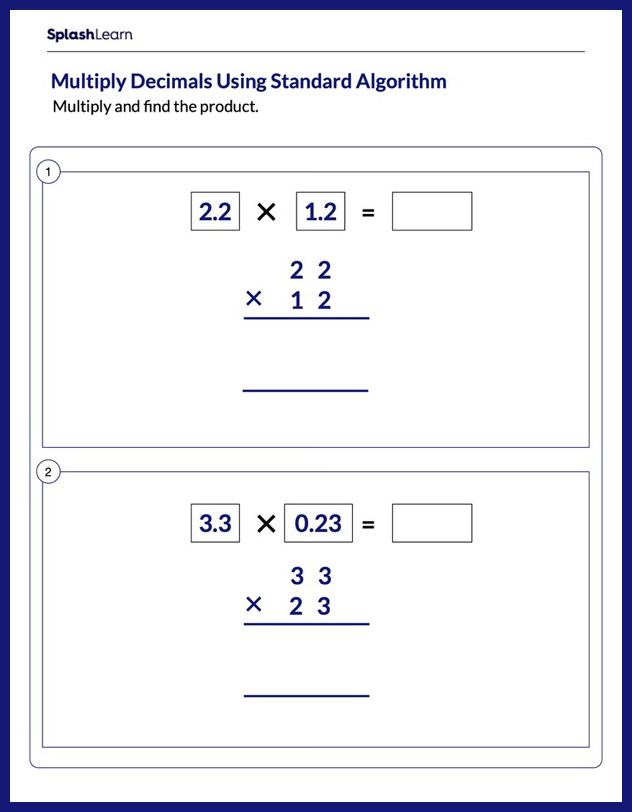
Multiplying decimals involves understanding place value, alignment, and the manipulation of decimal points. The process begins by treating the decimals as whole numbers, performing the multiplication as usual, and then adjusting the decimal point based on the number of decimal places in the original numbers.
The key to successful decimal multiplication lies in recognizing that the decimal point serves as a placeholder, indicating the value's magnitude. By aligning the decimal points and treating the numbers as if they were whole, you can execute the multiplication without the initial complexity of the decimal system. This approach simplifies the calculation, allowing you to focus on the core arithmetic operations.
Historical Background and Evolution
The concept of decimals and their multiplication traces back to ancient civilizations, with notable contributions from the Babylonians, Egyptians, and Greeks. However, the modern decimal system, based on the base-10 numeral system, gained prominence during the Renaissance. The invention of the printing press and the widespread adoption of Arabic numerals further facilitated the development and dissemination of decimal multiplication techniques.
Table of Contents
- The Complete Overview of How to Multiply Using Decimals
- Historical Background and Evolution
- Core Mechanisms: How It Works
- Key Benefits and Crucial Impact
- Major Advantages
- Comparative Analysis
- Future Trends and Innovations
- Conclusion
- Comprehensive FAQs
- Q: What is the first step in multiplying decimals?
- Q: How do I adjust the decimal point after multiplying decimals?
- Q: Is there a quicker way to multiply decimals besides long multiplication?
- Q: How can I avoid errors when multiplying decimals?
- Q: Why is multiplying decimals important in real-world applications?
Over time, various methods for multiplying decimals emerged, reflecting the evolving understanding of arithmetic and the need for more efficient calculation techniques. The traditional long multiplication method, still taught today, was developed during the 16th and 17th centuries. This method involves aligning the numbers by their place values, multiplying each digit in the bottom number by each digit in the top number, and then combining these products to obtain the final result.
Core Mechanisms: How It Works
At its core, multiplying decimals involves three primary steps: alignment, multiplication, and adjustment. First, the decimal numbers are aligned so that the decimal points are directly beneath one another. This alignment ensures that the place values line up correctly, facilitating the multiplication process.
Next, the numbers are multiplied as if they were whole numbers, ignoring the decimal points. This step leverages the familiar long multiplication method, where each digit in the multiplier is multiplied by each digit in the multiplicand, shifting the result one place value to the left with each subsequent multiplication. The products are then summed to obtain the initial, unadjusted result.
Key Benefits and Crucial Impact
Mastering the art of multiplying decimals offers a multitude of benefits, impacting various aspects of our lives. From accurate financial transactions to precise scientific measurements, the ability to handle decimals with confidence is invaluable.
“Mathematical literacy, particularly in numerical skills like decimal multiplication, significantly contributes to economic development by enhancing productivity and innovation.” - ResearchGate
Major Advantages
- Precision: Multiplying decimals accurately ensures precise results in fields such as engineering, medicine, and finance, where small errors can have significant consequences.
- Versatility: Decimal multiplication is applicable across various industries, from calculating discounts in retail to computing statistical data in research.
- Problem-Solving: Proficiency in multiplying decimals enhances overall problem-solving skills, enabling individuals to tackle complex numerical challenges with confidence.
- Financial Literacy: Accurate decimal multiplication is crucial for financial literacy, empowering individuals to manage their finances effectively, from budgeting to investing.
- Technological Integration: In an increasingly digital world, understanding decimal multiplication remains essential for utilizing technological tools and software that rely on numerical calculations.

Comparative Analysis
| Method | Description | Pros | Cons |
|---|---|---|---|
| Long Multiplication | Traditional step-by-step method aligning decimals and multiplying digit by digit. | Accurate, systematic, and widely taught. | Can be time-consuming and requires careful alignment. |
| Mental Math | Performing multiplication in the head, estimating or rounding decimals as needed. | Fast and flexible, useful for quick calculations. | Less precise, prone to errors, especially with larger numbers. |
| Calculator Use | Utilizing electronic calculators to perform decimal multiplication instantly. | Highly accurate, quick, and convenient. | Reliance on technology may hinder understanding and manual calculation skills. |
| Estimation | Approximating the product by rounding decimals and using known multiplication facts. | Useful for getting a rough estimate quickly. | Not precise, may not be suitable for applications requiring exact values. |
Future Trends and Innovations
As technology continues to advance, the landscape of numerical calculations, including decimal multiplication, is evolving. The rise of artificial intelligence, machine learning, and quantum computing promises revolutionary changes in how we approach complex mathematical operations.
Despite these technological advancements, the fundamental skills of multiplying decimals will remain essential. The ability to perform manual calculations, understand place value, and manipulate decimals will continue to be valuable in education, work, and daily life. Moreover, as technology integrates further into our numerical workflows, a solid grasp of decimal multiplication will be crucial for verifying results, troubleshooting algorithms, and ensuring the accuracy of computational processes.

Conclusion
Multiplying decimals is a fundamental skill with far-reaching implications. From its historical roots to its future applications, understanding how to multiply using decimals empowers individuals across various fields. By mastering this essential arithmetic operation, we enhance our numerical literacy, improve problem-solving abilities, and contribute to broader economic and technological advancements.
Whether through traditional long multiplication, mental math, or technological aids, the ability to confidently and accurately multiply decimals remains a cornerstone of mathematical proficiency. As we navigate an increasingly data-driven world, this skill will continue to be indispensable, ensuring precision, reliability, and innovation in countless endeavors.
Comprehensive FAQs
Q: What is the first step in multiplying decimals?
A: The first step in multiplying decimals is to align the numbers by their decimal points, ensuring that the place values line up correctly.
Q: How do I adjust the decimal point after multiplying decimals?
A: After multiplying the numbers as whole numbers, count the total number of decimal places in the original numbers. Then, move the decimal point in the product to the left by that many places.
Q: Is there a quicker way to multiply decimals besides long multiplication?
A: Yes, mental math and estimation techniques can be used for quick decimal multiplication. However, these methods may sacrifice precision, especially with larger or more complex numbers.
Q: How can I avoid errors when multiplying decimals?
A: To avoid errors, double-check your alignment of decimal points and be careful when shifting digits during the multiplication process. Verifying your final answer by performing the calculation in a different way can also help catch mistakes.
Q: Why is multiplying decimals important in real-world applications?
A: Multiplying decimals accurately is crucial in real-world applications such as financial transactions, scientific measurements, engineering calculations, and data analysis, where precision is essential to avoid costly mistakes or unsafe outcomes.
Leave a Comment
Comments are moderated before appearing. The data you submit is processed according to the Privacy Policy of stanford.edu.