Does a Sphere Have Infinite Surface Area? Unraveling the Mathematical Paradox
The Complete Overview of Does a Sphere Have Infinite Surface Area?
The question "does a sphere have infinite surface area?" sits at the intersection of mathematics, philosophy, and physics, tantalizing thinkers with its apparent paradox. On one hand, a sphere appears to have a well-defined, finite surface area. On the other, certain mathematical constructions suggest this area could extend infinitely. This conundrum invites us to delve into the very nature of space, dimension, and the limits of our understanding.
This exploration transcends mere academic curiosity. The concept of infinite surface area has profound implications for fields ranging from cosmology to fractal geometry. It challenges us to refine our definitions, question our assumptions, and explore the boundaries of what is knowable. Ultimately, the question of a sphere's surface area becomes a lens through which we examine the fundamental principles governing our universe.
Historical Background and Evolution
The notion that a sphere might possess an infinite surface area has its roots in the ancient philosophical debates about the nature of space and infinity. Greek philosophers like Zeno of Elea grappled with paradoxes involving the concept of infinity, foreshadowing the complexities we encounter today.Mathematically, the idea gained traction with the development of calculus in the 17th and 18th centuries. Mathematicians like Leibniz and Newton began exploring the behavior of functions and curves, leading to the discovery of fractal-like patterns and self-similar structures. These discoveries hinted at a deeper connection between infinity and the geometry of shapes, including spheres.
Core Mechanisms: How It Works
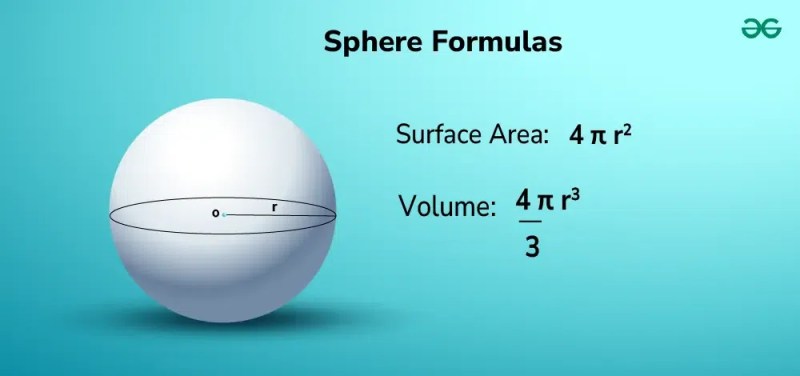
At first glance, calculating a sphere's surface area seems straightforward. The familiar formula, 4πr², provides a clear and finite result based on the sphere's radius. However, the paradox arises when we consider alternative approaches and perspectives.One such approach involves fractal geometry. Fractals are shapes that exhibit self-similarity across different scales. When applied to a sphere, fractal analysis suggests that its surface can be infinitely subdivided into smaller and smaller features, each contributing to an ever-increasing surface area. This infinite complexity, while counterintuitive, highlights the limitations of our traditional geometric frameworks.
Another avenue leading to the notion of infinite surface area involves the concept of "non-Euclidean" geometries. In these alternative geometric systems, the familiar rules of Euclidean geometry no longer apply. In certain non-Euclidean geometries, the surface area of a sphere can indeed be infinite, challenging our conventional understanding of space and shape.
Key Benefits and Crucial Impact
The exploration of whether a sphere has an infinite surface area, while seemingly abstract, has far-reaching implications and benefits across various domains:“The infinite is not only a mathematical concept but also a profound philosophical and scientific one, pushing the boundaries of our understanding and shaping our worldview.” - George Lakoff, Cognitive Linguist
Major Advantages
- Enhanced Mathematical Understanding: Investigating this paradox deepens our understanding of geometry, calculus, and the nature of infinity, leading to new mathematical insights and discoveries.
- Advancing Fractal Geometry: The study of fractals, spurred by this question, has applications in fields ranging from computer graphics and image compression to the study of natural phenomena like coastlines and tree growth patterns.
- Cosmic Implications: The concept of infinite surface area in non-Euclidean geometries has profound implications for our understanding of the universe. It opens doors to new models of cosmology and the possibility of multidimensional spaces.
- Philosophical Insights: This paradox challenges our assumptions about reality, space, and knowledge, inspiring philosophical reflections on the nature of infinity, perception, and the limits of human understanding.
- Innovation Catalyst: The quest to resolve this apparent contradiction fosters a spirit of inquiry and innovation, driving advancements in mathematics, physics, and technology.

Comparative Analysis
| Aspect | Finite Surface Area (Euclidean Geometry) | Infinite Surface Area (Fractal/Non-Euclidean Geometries) |
|---|---|---|
| Definition | Clearly defined and calculable using standard formulas | Emerges from self-similarity, fractal patterns, or alternative geometric systems |
| Implications | Provides concrete understanding of sphere properties | Challenges conventional notions of space, opens doors to new cosmological models |
| Applications | Engineering, architecture, physics (e.g., planet calculations) | Fractal analysis, chaos theory, multidimensional physics |
| Philosophical Significance | Aligns with classical philosophical perspectives | Provokes questions about the nature of reality and infinity |
Future Trends and Innovations
The question of a sphere's surface area continues to inspire ongoing research and innovation. Emerging fields like string theory and quantum gravity are exploring the possibility of multidimensional spaces and alternative geometric structures, potentially offering new insights into this paradox.Advances in computer science and artificial intelligence are also playing a crucial role. Machine learning algorithms are being used to analyze complex fractal patterns and simulate non-Euclidean geometries, pushing the boundaries of our understanding and opening up new avenues for exploration.

Conclusion
The question "does a sphere have infinite surface area?" remains a captivating and unresolved enigma. It invites us to confront the limitations of our knowledge, challenge deeply held assumptions, and explore the uncharted territories of mathematics, physics, and philosophy.Table of Contents
- The Complete Overview of Does a Sphere Have Infinite Surface Area?
- Historical Background and Evolution
- Core Mechanisms: How It Works
- Key Benefits and Crucial Impact
- Major Advantages
- Comparative Analysis
- Future Trends and Innovations
- Conclusion
- Comprehensive FAQs
- Q: What is the traditional formula for calculating a sphere's surface area?
- Q: How can fractal geometry lead to the concept of infinite surface area?
- Q: What are non-Euclidean geometries, and how do they relate to infinite surface area?
- Q: What are some practical applications of understanding a sphere's surface area?
- Q: How do computer science and artificial intelligence contribute to this exploration?
While a definitive answer may elude us for now, the journey itself is invaluable. It exemplifies the enduring spirit of scientific inquiry, pushing us to constantly refine our understanding of the universe and our place within it.
Comprehensive FAQs
Q: What is the traditional formula for calculating a sphere's surface area?
A: The traditional formula for calculating the surface area of a sphere is 4πr², where r represents the radius of the sphere.
Q: How can fractal geometry lead to the concept of infinite surface area?
A: Fractal geometry suggests that a sphere's surface can be infinitely subdivided into smaller, self-similar structures. Each subdivision increases the surface area, leading to the concept of infinite complexity and, consequently, infinite surface area.
Q: What are non-Euclidean geometries, and how do they relate to infinite surface area?
A: Non-Euclidean geometries are alternative geometric systems where the standard rules of Euclidean geometry (like the sum of angles in a triangle equaling 180 degrees) do not apply. In certain non-Euclidean geometries, the surface area of a sphere can be infinite.
Q: What are some practical applications of understanding a sphere's surface area?
A: A sphere's surface area has practical applications in fields like engineering (designing spherical objects), architecture (domes and spherical structures), and physics (calculating planetary radii and gravitational interactions).
Q: How do computer science and artificial intelligence contribute to this exploration?
A: Computer science and AI are used to analyze complex fractal patterns, simulate non-Euclidean geometries, and explore multidimensional spaces, advancing our understanding of the paradox and opening new avenues for research.
Leave a Comment
Comments are moderated before appearing. The data you submit is processed according to the Privacy Policy of stanford.edu.