Unveiling the Shared Multiples: Exploring the Common Multiples of 18 and 30
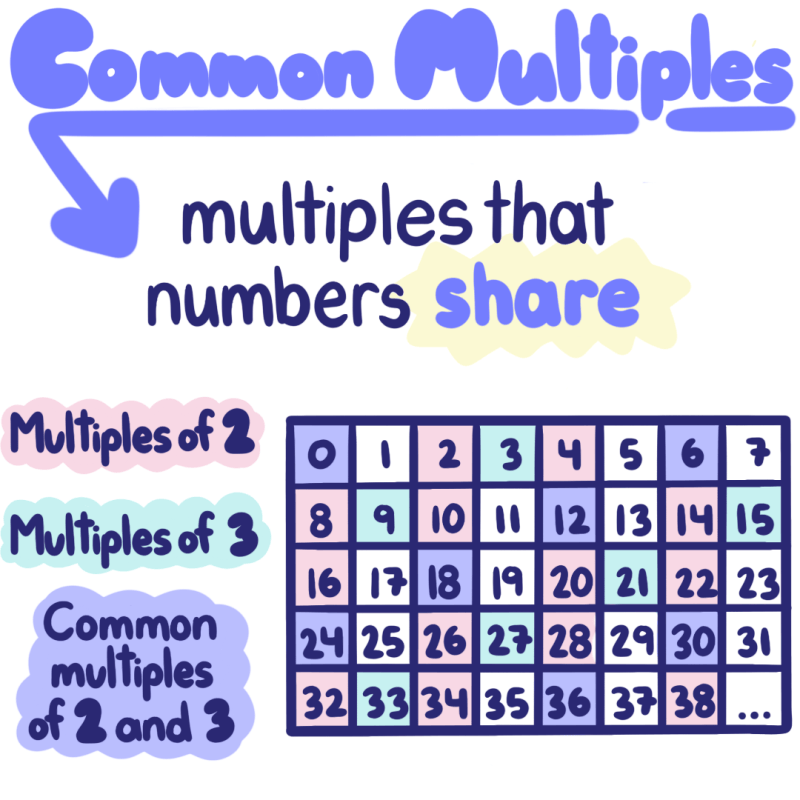
The Complete Overview of Common Multiples of 18 and 30
Understanding the common multiples of 18 and 30 is a fundamental concept in mathematics, offering insights into the interplay between numbers and their applications in various fields. This exploration delves into the intricacies of these multiples, their historical relevance, and their practical implications. Whether you're a student, educator, or enthusiast, grasping this concept can significantly enhance your numerical literacy.
At its core, a multiple of a number is the product of that number and an integer. When we discuss the common multiples of 18 and 30, we are essentially seeking the numbers that can be expressed as a multiple of both 18 and 30. These shared multiples hold significance in various contexts, from simplifying calculations to solving complex problems in engineering and physics.
Historical Background and Evolution
The study of multiples and common divisors dates back to ancient civilizations, including the Babylonians and Greeks. Early mathematicians recognized the importance of prime factorization and the fundamental theorem of arithmetic, which states that every integer greater than 1 is either a prime number or can be uniquely represented as a product of prime numbers. This theorem forms the basis for understanding multiples and their common factors.Over time, the concept of multiples evolved from simple arithmetic to a powerful tool in advanced mathematics. The development of number theory in the 17th and 18th centuries further solidified the importance of understanding multiples and their properties. Today, the common multiples of 18 and 30 are not just academic curiosities but essential knowledge for professionals in various fields.
Core Mechanisms: How It Works
To identify the common multiples of 18 and 30, one must first understand the prime factorization of these numbers. The prime factorization of 18 is 2 × 3^2, while 30 can be broken down into 2 × 3 × 5. The common multiples are found by taking the highest powers of each prime factor present in both numbers.For instance, the first few common multiples of 18 and 30 are 90, 180, 270, and so on. Each of these numbers contains the prime factors 2, 3, and 5 raised to at least the highest power found in the original numbers. This method ensures that the resulting multiples are divisible by both 18 and 30.
Key Benefits and Crucial Impact
Understanding the common multiples of 18 and 30 has far-reaching implications across various domains. From simplifying everyday calculations to solving complex engineering problems, this knowledge proves invaluable."Mathematics is the language with which we describe the patterns that we see in the world around us." - Richard Hamming
Major Advantages
- Simplified Calculations: Common multiples reduce the complexity of calculations involving 18 and 30, making them easier to manage in various scenarios.
- Enhanced Problem-Solving: In fields like physics and engineering, understanding multiples aids in solving problems related to frequency, speed, and other measurable quantities.
- Pattern Recognition: Identifying common multiples helps in recognizing patterns in numerical data, facilitating better analysis and interpretation.
- Educational Foundation: This concept forms a crucial part of mathematical education, laying the groundwork for more advanced topics in number theory and beyond.
- Practical Applications: From construction and manufacturing to computer science, the common multiples of 18 and 30 find applications in numerous professional fields.

Comparative Analysis
| Aspect | Multiples of 18 | Multiples of 30 |
|---|---|---|
| Prime Factorization | 2 × 3^2 | 2 × 3 × 5 |
| First Common Multiple | 90 | 90 |
| Applications | Theoretical mathematics, frequency calculations | Construction, timekeeping, financial cycles |
| Educational Focus | Fundamental in primary education | Introduced in early secondary education |
Future Trends and Innovations
As technology advances, the role of mathematics in various industries continues to evolve. The understanding of common multiples, including those of 18 and 30, will likely become even more integrated into emerging fields such as artificial intelligence, data science, and quantum computing.The need for efficient algorithms and precise calculations in these fields underscores the importance of fundamental mathematical concepts. Common multiples play a crucial role in optimizing processes, reducing computational complexity, and ensuring the accuracy of results. As such, they are poised to remain a vital component of mathematical education and professional practice.
Table of Contents
- The Complete Overview of Common Multiples of 18 and 30
- Historical Background and Evolution
- Core Mechanisms: How It Works
- Key Benefits and Crucial Impact
- Major Advantages
- Comparative Analysis
- Future Trends and Innovations
- Conclusion
- Comprehensive FAQs
- Q: What are the first five common multiples of 18 and 30?
- Q: How are common multiples of 18 and 30 used in real-world applications?
- Q: Why is understanding prime factorization important for finding common multiples?
- Q: Can common multiples of 18 and 30 be negative?
- Q: How does knowledge of common multiples benefit students in their mathematical journey?

Conclusion
The common multiples of 18 and 30 represent a fascinating intersection of mathematical theory and practical application. From their historical roots to their modern-day impact, these multiples demonstrate the enduring relevance of number theory in our world. Whether for simplifying everyday calculations or solving complex problems in specialized fields, understanding this concept empowers us to navigate the numerical landscape with greater confidence and precision.As we continue to explore and innovate, the fundamentals of mathematics, including the study of multiples, will remain a cornerstone of human knowledge, shaping our understanding of the world and driving us toward new discoveries.
Comprehensive FAQs
Q: What are the first five common multiples of 18 and 30?
A: The first five common multiples of 18 and 30 are 90, 180, 270, 360, and 450.
Q: How are common multiples of 18 and 30 used in real-world applications?
A: Common multiples are used in various applications, such as calculating frequencies in physics, determining time intervals in scheduling, and in financial cycles like monthly payments or budgeting.
Q: Why is understanding prime factorization important for finding common multiples?
A: Prime factorization helps identify the highest powers of each prime factor present in both numbers, ensuring that the resulting multiples are divisible by both 18 and 30.
Q: Can common multiples of 18 and 30 be negative?
A: Yes, common multiples can be negative. For instance, -90, -180, and so on, are also common multiples of 18 and 30.
Q: How does knowledge of common multiples benefit students in their mathematical journey?
A: Knowledge of common multiples strengthens students' understanding of number theory, enhances problem-solving skills, and provides a foundation for more advanced mathematical concepts.
Leave a Comment
Comments are moderated before appearing. The data you submit is processed according to the Privacy Policy of stanford.edu.